Guided PPWR documentation — and validation software.
PPWR compliance software that turns Regulation (EU) 2025/40 into a per-product checklist.
Enter your packaging data once. The toolkit returns what each pack needs, what evidence is still missing, and the declarations, markings and reports that close the gap. It covers the EU-27, the UK and Finland's producer-responsibility duties.
Free for active Toolcat clients · 14-day free trial otherwise, no credit card
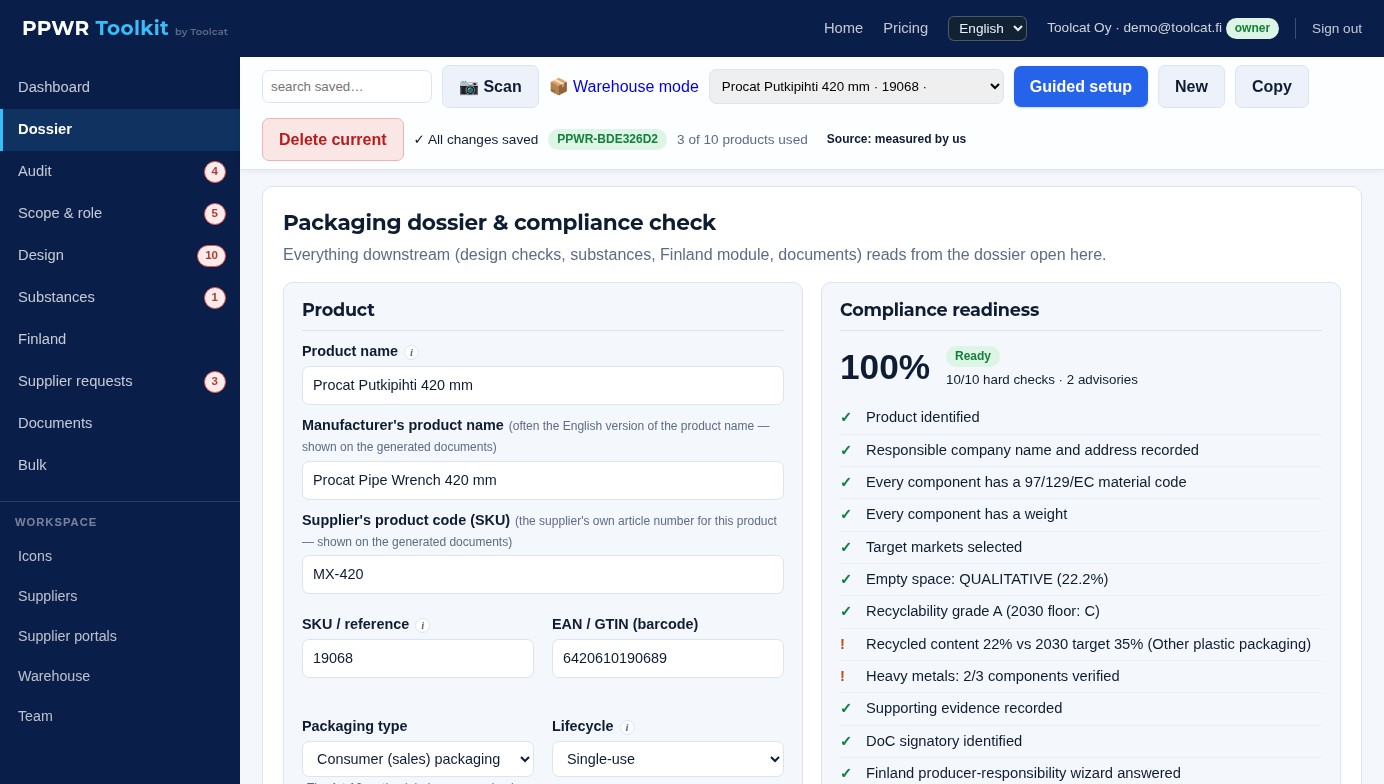
The workspace we run our own catalogue on.
Not slideware: these are the screens Toolcat uses every week. A live readiness matrix per product. Declarations that render in every market's language. A guided setup that walks a non-specialist through the whole flow.
Buy from Toolcat? The toolkit is on us.
Retailers and industry customers actively ordering from Toolcat get full, free access to PPWR Toolkit. That means the same workspace, every document, and no product limit. Our goods carry their PPWR paperwork through to you, and the tool keeps your side of the compliance organized. It is how a supplier should help its partners meet the regulation, not just ship around it.
We built it because we needed it — so it fits how a real operation works.
PPWR Toolkit was not designed in a vacuum by a software house. It was built inside a working importer and wholesaler, against real suppliers, real catalogues and real deadlines. That is why it handles the awkward parts instead of the tidy demo case. Those parts are factories that don't volunteer test data, resellers who only verify, and catalogues of hundreds of SKUs. Anyone can subscribe. The businesses that trade with us use it free.
Why PPWR duties are per product and per market: twenty-seven producer registers, not one.
Most teams discover the PPWR (Regulation (EU) 2025/40, the Packaging and Packaging Waste Regulation) as a spreadsheet of unanswered questions. The regulation is directly applicable. But the duties that actually bite are national: who registers where, which label is mandatory, which deposit scheme takes this bottle.
One regulation, 27 rulebooks
A single EU registration is not a passport. You are a "producer" in your own Member State wherever you are the first to make the product available there. You are also a producer in any other market where you supply end users directly: consumers, or businesses that use the product themselves (Art 3(1)(15)). For direct-to-consumer sellers that can still mean 27 registrations, each with its own deadline, threshold and fee schedule. Italy mandates the material code. Finland does not. Get that backwards and you have printed the wrong artwork.
Missing evidence is not a pass
From 12 August 2026 you need a technical file and a signed declaration for the packaging you place on the market. Absence of test data does not read as compliant. It reads as unverified. Chinese suppliers rarely volunteer heavy-metal reports. So find the gap and chase it before you sign off the artwork, not after.
Catalogues, not products
Nobody has one SKU. Assessing four hundred products by hand is a quarter of work. It is out of date the moment a supplier changes a film. The answer has to come from data you already hold, and be recomputed when the data changes.
Easy to fill — and one click to request what you can't.
Entering what you already know takes minutes. Getting the right paperwork out of the supply chain used to take weeks. Now it is one click, and every remaining gap links straight to its fix. Retailer asks for your PPWR paperwork? Send a confirmation letter with a verification link.
The right paperwork, one click from the supply chain
The toolkit already knows which documents and data each product is missing. One click writes the whole request: the papers to sign, and the email that asks for them. The email carries the subject, the body and the supplier's own portal link, in the supplier's language. Send it from your mail app, or straight from the service. The supplier gets one page to fill in, no account needed. No generic questionnaires, no attachments to chase by hand.
A color system everyone reads the same way
Green passes, amber is declared but still waiting for evidence, red is a gap. The same traffic light runs through the app, the warehouse view and the supplier portal. A buyer, a warehouse worker and a supplier all see the same status without training.
Dynamic links that land on the fix
Every gap in the readiness matrix is a link. It takes you straight to the field, document or wizard step behind the problem. It tells you what closes it. No hunting through tabs, no decoding what 'non-compliant' means.
Your factories and your retailers get their own free workspace.
Link the companies you buy from and the shops you sell to. The other side confirms each link, and either side can end it. Nothing is shared before that.
Factory
Answers your requests in a free workspace of its own, with a six-step wizard per product. Everything it sends lands in your review queue, and you accept or reject it. Ask my supplier writes the letters to its own packaging maker, without naming you.
Wholesaler
That is you: the importer, brand owner or distributor that buys from factories and sells to retailers. You run the chain from the Supply chain tab, on Pro and above. Your factories never see your retailers.
Retailer
Reads your products in a free, read-only library: your traffic light as declared by you, the declarations of conformity you signed, your registration numbers per market and your marking confirmation. It sends you a typed request for anything missing.
Every module helps you answer one question: is this product ready to sell?
Each module reads the same dossier. An answer entered once lands everywhere: in the readiness matrix, in the audit workflow, and in every document you print. Guided setup walks you through all of them in one flow. More than thirty document types come out the other end.
Material marks that print
Every 97/129/EC code from 1 to 98 as one consistent artwork, recolourable, abbreviation band on or off, with the composite C/ convention handled. Export as SVG or PNG up to 2048 px. Batch-generate a whole artwork sheet from a CSV.
Article readiness matrix
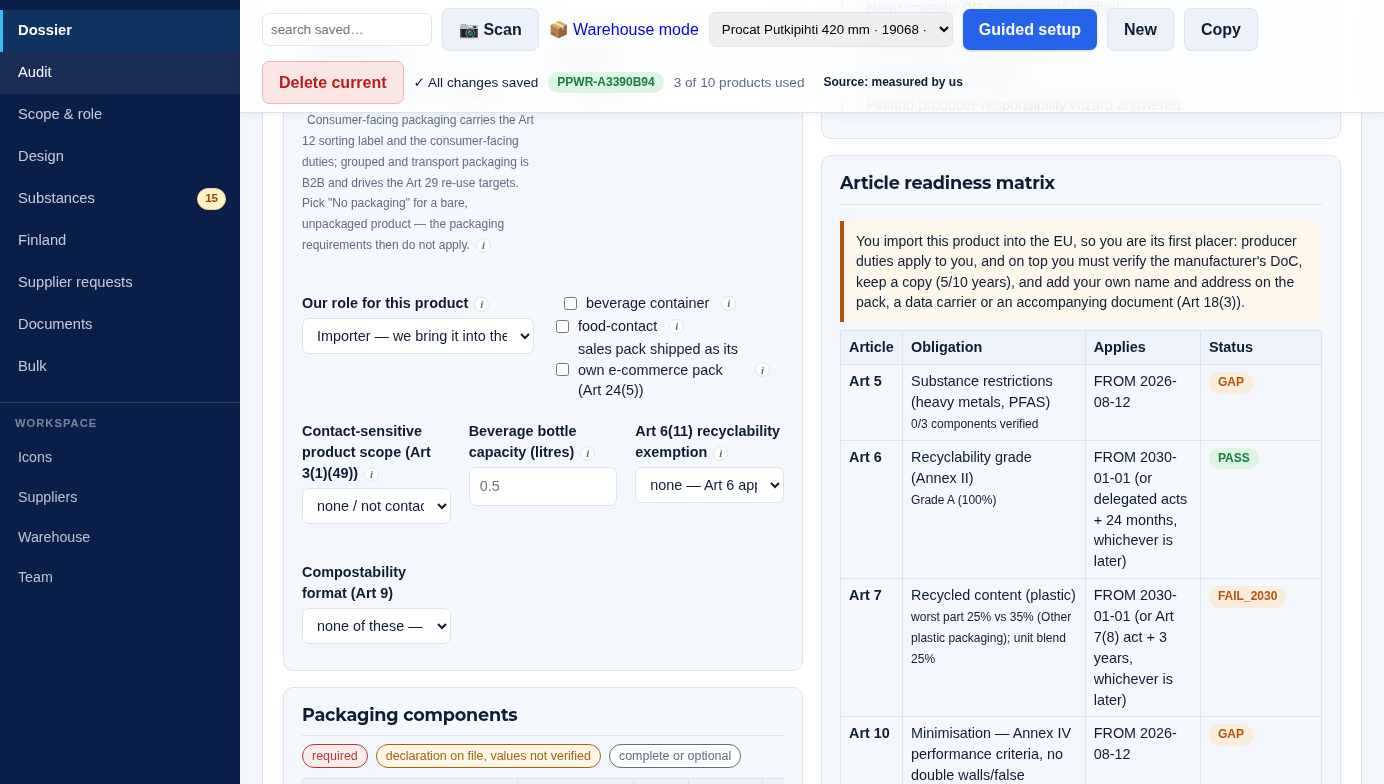
Arts 5 to 45 on one screen, with a live state per row: pass, gap, fail, or waiting on a Commission implementing act. Every verdict defers to the engine that owns it. So the matrix cannot claim your declaration is ready while it is un-issuable.
Design checks with numbers
Provisional Annex II recyclability grade estimated by weight, with the gap to the next grade in grams. Art 7 recycled content across the four categories with the sub-5 % exemption applied. Art 24 empty space from real dimensions, counting filler as void.
Art 5 substances, done properly
A heavy-metals ledger per component against the Art 5(4) 100 mg/kg sum. Then the PFAS (per- and polyfluorinated alkyl substances, often called forever chemicals) screen for food contact. It reads the 25 µg/kg, 250 µg/kg and 50 mg/kg limits that bind from 12 August 2026, plus the separate 50 mg/kg total-fluorine speciation trigger. No test data means unverified, never a pass.
Deposit-return screening
Screens every market, the EU-27 and the UK: 17 live deposit schemes and 6 announced. It screens by volume band, ABV, refillable treatment and glass carve-outs. It also lists the marking each operator requires before you release artwork.
The documents themselves
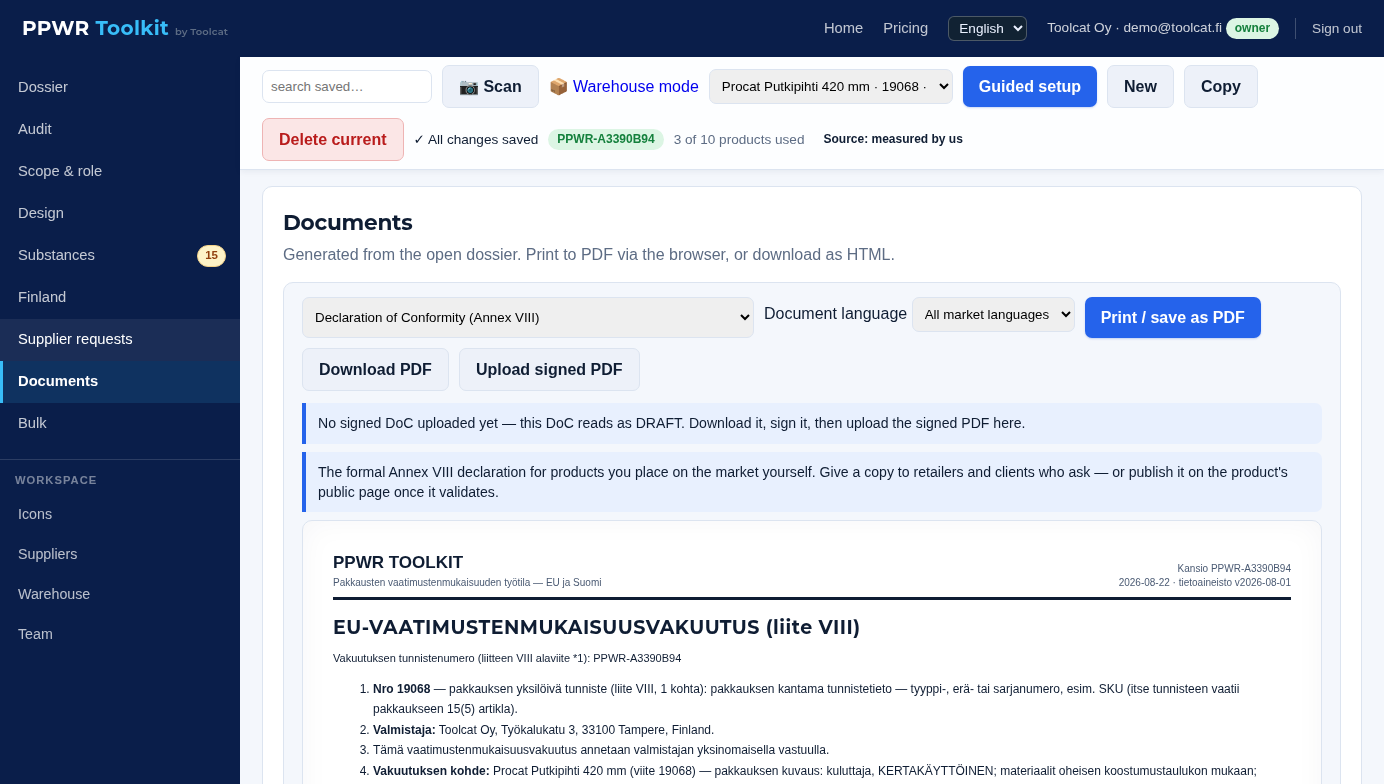
Annex VIII declaration of conformity with a validator that refuses to render an incomplete one. Annex VII technical file with gap badges. Supplier data request and a pre-filled declaration for signature. Download as a real PDF, or print from the browser.
National labelling, split correctly
Italy and Spain let you compose the sorting label, so the toolkit generates it per component. France's Triman block and every deposit mark belong to a scheme, so it writes the request instead. Guessing which is which is how a pack ends up carrying a mark nobody had the right to print.
Guided setup, one flow
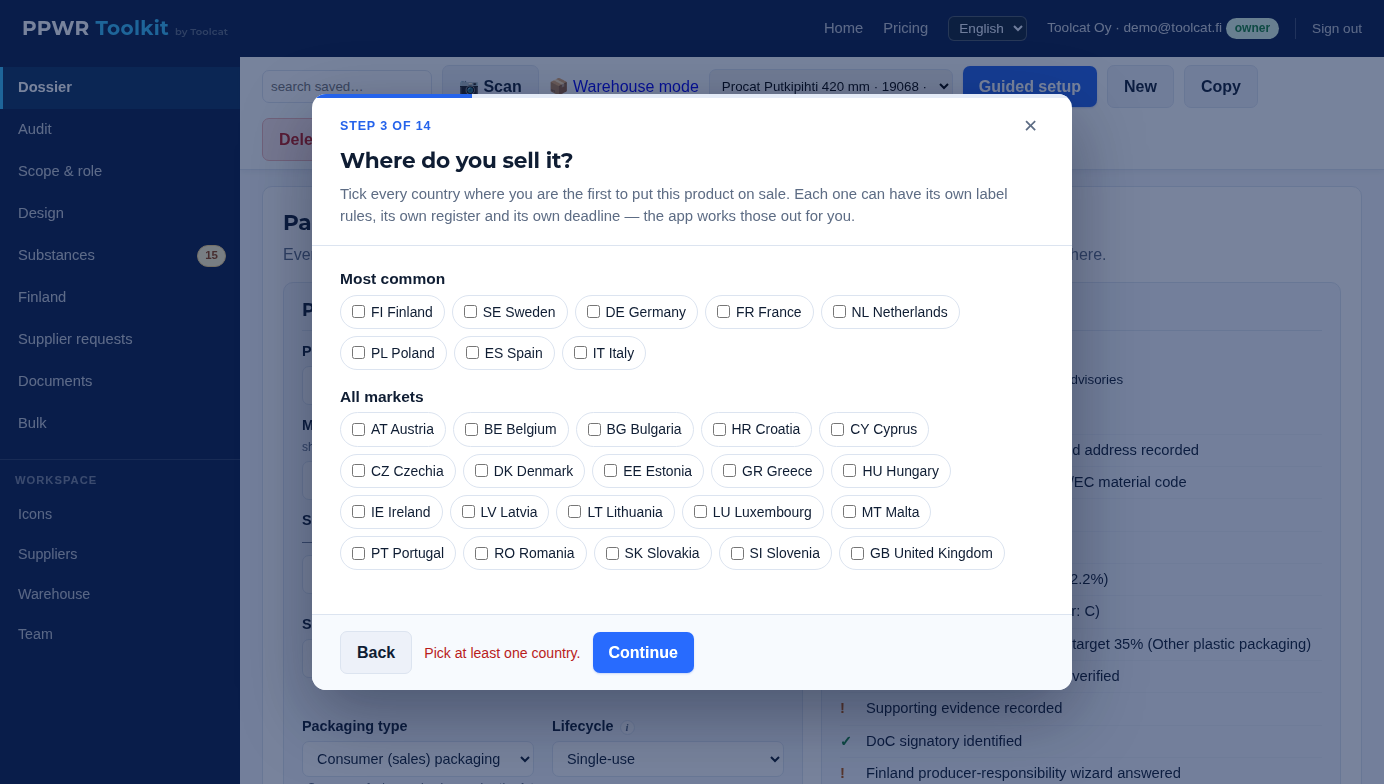
Every field in the dossier as one continuous set of questions, each explained in plain language, with no tab-hopping. The flow adapts as you answer. A drink adds the deposit steps. Food contact adds PFAS. Finland adds producer responsibility.
Warehouse mode for the people who hold the box
Weights and pack quantities come from whoever has the carton in their hands. A warehouse account opens one phone-first screen, scans the product's EAN and reads the traffic light. Green means the packaging data is complete: put it away and scan the next one. Amber lists exactly what to fill in: component name, material code, weight in grams, units per inner pack and per master carton. The app stamps what they enter as measured in-house and writes it to the audit log. They see nothing else about the product.
Six steps from "we don't know" to "gathered, organized and documented".
The same workflow runs for one product or for four hundred. The app computes every step live from the dossier. The catalogue view shows all six states for every product on one screen.
Determine your role
Is the item even packaging under Art 3(1)? Are you the manufacturer, the importer, or caught by the Art 21 rebranding trap? Your duties follow from the answer. Company size matters too. A micro-enterprise with an EU packaging supplier hands the Art 15 paperwork to that supplier (Art 15(12)). It never hands over the registration or the fees.
Complete the product data
Components, materials, weights, recycled content, heavy metals. Whatever is missing becomes a supplier data request you can send under Art 16.
Register per market
One row per target market with the register name, the deadline and your registration number tracked to completion.
Confirm the artwork
A checklist of mandatory elements, from this product's markets, role and deposit screening. It separates what the law requires from what is merely convention.
Issue the documents
Declaration of conformity and technical file, generated from the dossier and refusing to render while a required block is empty.
File the evidence
An evidence register with expiry tracking and the retention clock — five years from last placing, ten for reusables.
Built for a whole catalogue
Import every dossier field from one spreadsheet: over 300 columns, one row per component. Rows that share a product and SKU merge into one dossier. The Excel template ships with real dropdowns on every field that has a fixed set of values. An import therefore cannot carry a typo.
- Validated before anything is written — one bad cell rejects the sheet whole, with the row and column named.
- Round-trip: export the catalogue, enrich in Excel, re-import with overwrite.
- Built for catalogues of hundreds of products: audit scoring is cached and the overview paginates.
- The whole team works in one workspace: owner, administrator, member and warehouse roles, unlimited people on every plan, no per-seat price.
The toolkit that also does the national producer-responsibility paperwork: Finland first, and eleven more markets.
PPWR is the EU layer. In Finland you also owe producer responsibility under jätelaki 646/2011 and VNA 1029/2021. VNA is the Valtioneuvoston asetus pakkauksista ja pakkausjätteistä 1029/2021, the Government Decree on packaging and packaging waste. In Finland, who counts as a "producer" widened on two dates. Since 1 January 2024, the producer of service packaging and primary-production packaging is the manufacturer or importer of that packaging. The million-euro turnover threshold no longer applies. From 12 August 2026, the PPWR moves producer responsibility for transport packaging. It moves from the company that packs the goods to the manufacturer or importer of the packaging.
- Eligibility wizard covering both widenings of the producer definition, 2024 and 2026, including distance sellers.
- Fee calculator on the published Sumi 2026 and Suomen Pakkaustuottajat 2026 per-kilo price lists. It keeps the 2025 SPT (Suomen Pakkaustuottajat Oy) list for earlier reporting periods. It covers consumer and business channels, the clamped service fee and VAT at 25.5 %.
- Late-filing and laiminlyöntimaksu (neglect fee) exposure, so the cost of ignoring it is on the same screen as the cost of complying.
- Palpa module: deposit by container and volume, reverse-vending geometry, barcode and mark sizes, and the beverage-tax comparison at your volumes.
- Rinki/Sumi-ready data sheet and the FI/SV stream vocabulary.
Authority handover tracked
The producer register moved from the Pirkanmaa ELY Centre to Lupa- ja valvontavirasto on 1 January 2026. ELY: Elinkeino-, liikenne- ja ympäristökeskus, one of the regional state authorities. Tukes is the market-surveillance authority for packaging requirements under jätelaki § 24 a, a role it already held before the PPWR applied. From 12 August 2026 that covers PPWR Arts 5, 6, 8-12, 14 and 24-26 and the Art 7 recycled-content minimums for other plastic packaging (VNA 1029/2021 § 23). The Art 7 minimums for contact-sensitive packaging and single-use plastic beverage bottles go to the food-control authorities (jätelaki § 24 a(4)). The dataset carries both, with the dates.
Kept current, on purpose
The regulatory datasets are versioned and separated from the code. A scheduled watch agent checks official sources: EUR-Lex, ministries, PRO (producer responsibility organisation) price lists. It cross-checks each country against its own primary source, and never mixes one Member State's rules into another's.
Free PPWR reference: the compliance timeline, the 97/129/EC material codes and per-country labelling rules.
The same datasets the app runs on, published as plain reference pages. No account, no paywall.
PPWR compliance timeline
Every date that matters between entry into force and 2040, with the article that drives it and which delegated and implementing acts are still outstanding.
97/129/EC material codes
Every assigned code with abbreviation, category, the mark itself, and a note on how well each material is actually collected.
Market requirements
Per country: is on-pack material marking mandatory, which register applies, what the deadline is, and whether a deposit scheme is live.
The PPWR compliance workflow by role
The steps a manufacturer, an importer and a distributor each owe, in order, with the article behind every one.
Finnish producer responsibility: Rinki, Sumi and Palpa
Who counts as a producer in Finland, the registration routes, the fee lists and both reporting deadlines.
Free material-mark generator
Any 97/129/EC code as print-ready SVG or PNG, in the browser, no sign-up.
PPWR for small businesses and micro-enterprises
What applies to a company with fewer than 10 staff, what can wait, and what does not apply — with every article cited.
PPWR Toolkit FAQ: consultants, missing test reports, data location, dataset currency — and what a small company, a reseller and a web shop must do.
Does this replace a compliance consultant?
No. It replaces the spreadsheet. The toolkit computes what the regulation says about the data you enter, shows its working, and cites the source. But it is informational, not legal advice. It flags provisional calculations with the delegated or implementing act they depend on. Most teams use it to arrive at a consultant with the questions already narrowed to the ones that need judgement.
We import from Asia and will never get test reports. Is that fatal?
For ordinary low-risk packaging — tools in a carton with a poly bag — the practical starting point is a signed supplier declaration covering Art 5. The toolkit ships a pre-filled one for signature. Once it is on file, the toolkit stops chasing per-component test data. The Annex VII technical file still has to hold the demonstration the declaration supports. PFAS on food-contact packaging is different: there is no stock-exhaustion transition, so that one needs analysis.
Where is our data stored?
In the PPWR Toolkit service, in a workspace isolated to your organisation. The application is a small self-contained service with no third-party dependencies: no analytics, no external fonts, no CDN (content delivery network). Analytics, where enabled at all, run on these public pages only and ask for consent first. Multi-tenant isolation sits at the database key. The service writes every sign-in, dossier change and account change to an audit log you can read. You can download a full backup of your workspace as a .zip. It holds the data plus every file you uploaded. It can be emailed to you weekly. A JSON data export is there too.
How current is the regulatory data?
Every dataset carries a version stamp. The toolkit prints it on the documents you generate, so an audit can tell which snapshot a decision was made against. A scheduled agent monitors official sources daily and updates the data, never the code. It flags anything that needs a code change as a separate issue.
What happens to the parts of the PPWR that are not decided yet?
They are shown as pending, not guessed. The Art 6 design-for-recycling criteria, the Art 7 calculation rules and the Art 12 pictograms all depend on acts that have not been adopted. The toolkit marks any figure that depends on one as provisional. It names the act and its due date, so you know which numbers will move.
Can we try it on our real catalogue?
Yes — that is the fastest way to see whether it fits. Fill in the Excel template, save it as CSV and import it on any plan, the free trial included. You can also add products by hand. The catalogue view then shows all six audit steps for every product. The free trial covers 5 products for 14 days.
Does the PPWR apply to a company with fewer than 10 staff?
Yes. Nothing in the Regulation switches off for small companies (Art 4(1), Arts 15-19, 38-39, 44-45). A micro-enterprise has targeted reliefs only. It is a company with fewer than 10 staff and turnover or balance sheet of at most EUR 2 million (Recommendation 2003/361/EC as applicable on 11 February 2025). Its EU-located packaging supplier counts as the manufacturer for the Art 15 paperwork (Art 15(12), Art 21). Re-use targets do not apply for a calendar year in which it made not more than 1 000 kg of packaging available in a Member State (Art 29(13)). The take-away re-use-offer duty does not apply (Art 33(4)). Member States may allow Annex V point 3 formats (Art 25(4)). Any producer that made less than 10 tonnes of packaging available in a Member State in a calendar year files the simplified Annex IX Part B point 2 report there, unless that Member State has set a lower threshold for the year (Art 44(8)). Details: the small-business page.
I only resell goods someone else packed. Am I a producer?
You are the producer for the packaging of goods you first make available in Finland, as an importer is (Art 3(1)(15)(b); jätelaki § 48(1) item 6 now refers to that definition). You are also the producer for goods you sell directly to end users in another Member State: consumers, or businesses that use the goods themselves (Art 3(1)(15)(d), Art 3(1)(23)). Reselling goods that a Finnish operator already made available in Finland makes you a distributor, not the producer. A distributor checks three things: that the producer is registered, that the label is there, and that the pack carries the manufacturer's type, batch or serial number, name and address and, for imported goods, the importer's name and address (Art 19(2)).
What must a web shop do by 12 August 2026?
It depends on your role. If you make or own-brand the packaging: technical file, declaration of conformity, identification and name on the pack (Art 15, Annex VII and VIII). If you import from outside the EU: the Art 18(2) checks, and your name and address (Art 18(3)). Keep a copy of the declaration for 5 or 10 years (Art 18(7)). If you only resell: the Art 19(2) checks. Every producer registers where it is the producer (Art 44(2), (4)). Appoint an EPR (extended producer responsibility) authorised representative in each other Member State you sell into directly (Art 45(3)). Give marketplaces and fulfilment providers your register number and self-certification (Art 45(4), (7)).
A tool you work with, not a service that works for you.
PPWR Toolkit exists to help you navigate the requirements and to keep everything you gather in one organized place. The knowledge of your products is yours, the work is yours, and the responsibility stays yours. We sell the structure, not the expertise.
What we are
Software: a checklist of what applies to each product. Calculators that show their working and cite their sources. One organized home for your evidence. Generated drafts for you to check, complete and sign.
What we are not
A certification body, a testing laboratory, a consultancy or a law firm. Nobody here reviews your data or checks your answers, and nothing the toolkit prints is an approval of anything.
Which is why it costs what it costs
A consultancy sells hours of an expert doing the work for you. This sells the structure for doing it yourself — once, with a tool that remembers it. That difference is the whole price list.
Find out where your catalogue actually stands.
Import your products, get six audit states per SKU, and print the documents you are missing. Free for 14 days, no credit card.