PPWR compliance software: one product dossier, every Regulation (EU) 2025/40 duty checked
PPWR (Regulation (EU) 2025/40, the Packaging and Packaging Waste Regulation) compliance software for importers, wholesalers, brand owners and web shops. Every module reads the same product record. Enter a component weight once. It then lands in the recyclability grade, the recycled-content sum, the Finnish fee estimate, the national labelling pack and the declaration of conformity.
Material identification marks
Every code assigned by Commission Decision 97/129/EC as uniform designed artwork, at any size, as SVG or PNG.
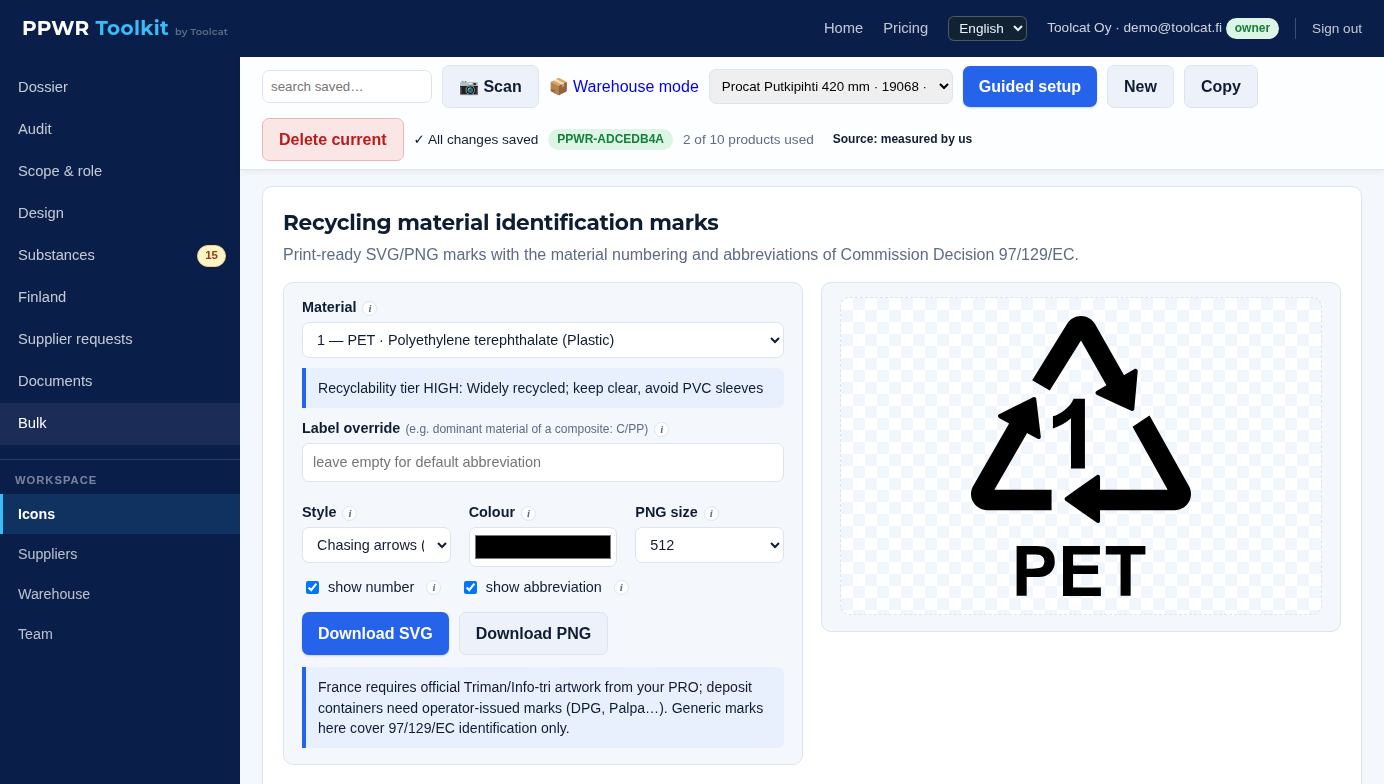
- One designed artwork set — all 34 marks with identical typography and geometry, print-ready.
- Composite handling: the C/ convention with the dominant material suggested per code.
- Recolour to match your artwork; show or hide the abbreviation band.
- Batch generation from a CSV into a printable artwork sheet.
- Clear about its limits: Triman, Info-tri and deposit marks must come from the scheme operator.
Product dossier and readiness
One record per product: components, materials, weights, evidence and target markets. Everything else reads from it.
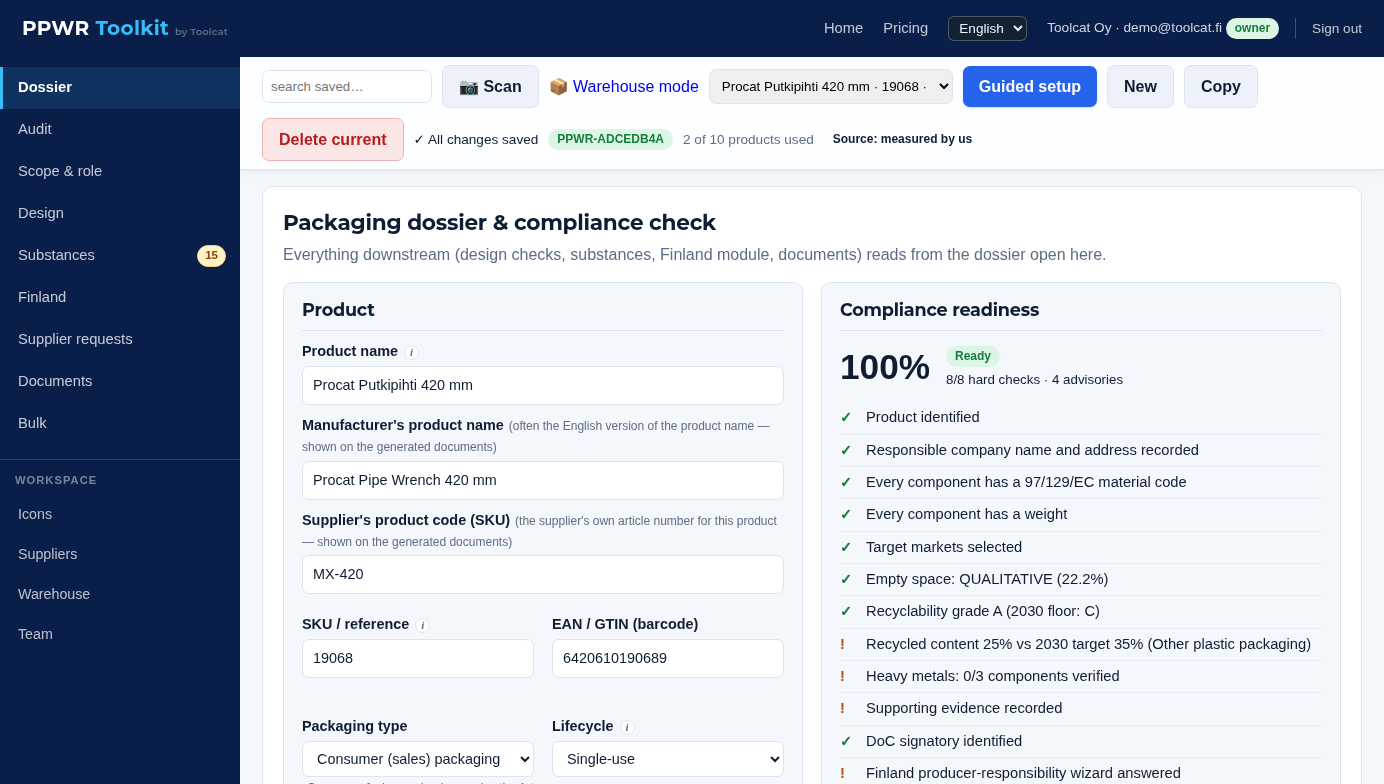
- Component table with material code, weight, recycled content, colour and separability.
- Article readiness matrix across Arts 5 to 45, each row deferring to the engine that owns it.
- The app works out empty space from your real dimensions. Filling material counts as void.
- A sorting check for what quietly breaks recycling. It looks for PVC, carbon black and layers you cannot pull apart.
- Evidence register with issue and expiry dates, and the retention clock from last placing.
- Packaging versions: when a supplier changes a film, add a version. The old dossier freezes for its retention clock. The app scores the new one. Only current versions count against the plan.
- Contact-sensitive product scope across ten regimes (Art 3(1)(49)), the Art 6(11) recyclability exemptions and the Art 9 compostable formats.
- A GS1 Digital Link for the consumer QR code, built from the product's GTIN (Global Trade Item Number). GS1: the barcode standards body.
Six-step audit workflow
The path from "unknown position" to "gathered, organized and documented". The app computes it live, and it repeats across the catalogue. The dashboard opens on a needs-attention list, the next five PPWR deadlines and the supplier submissions waiting for review.
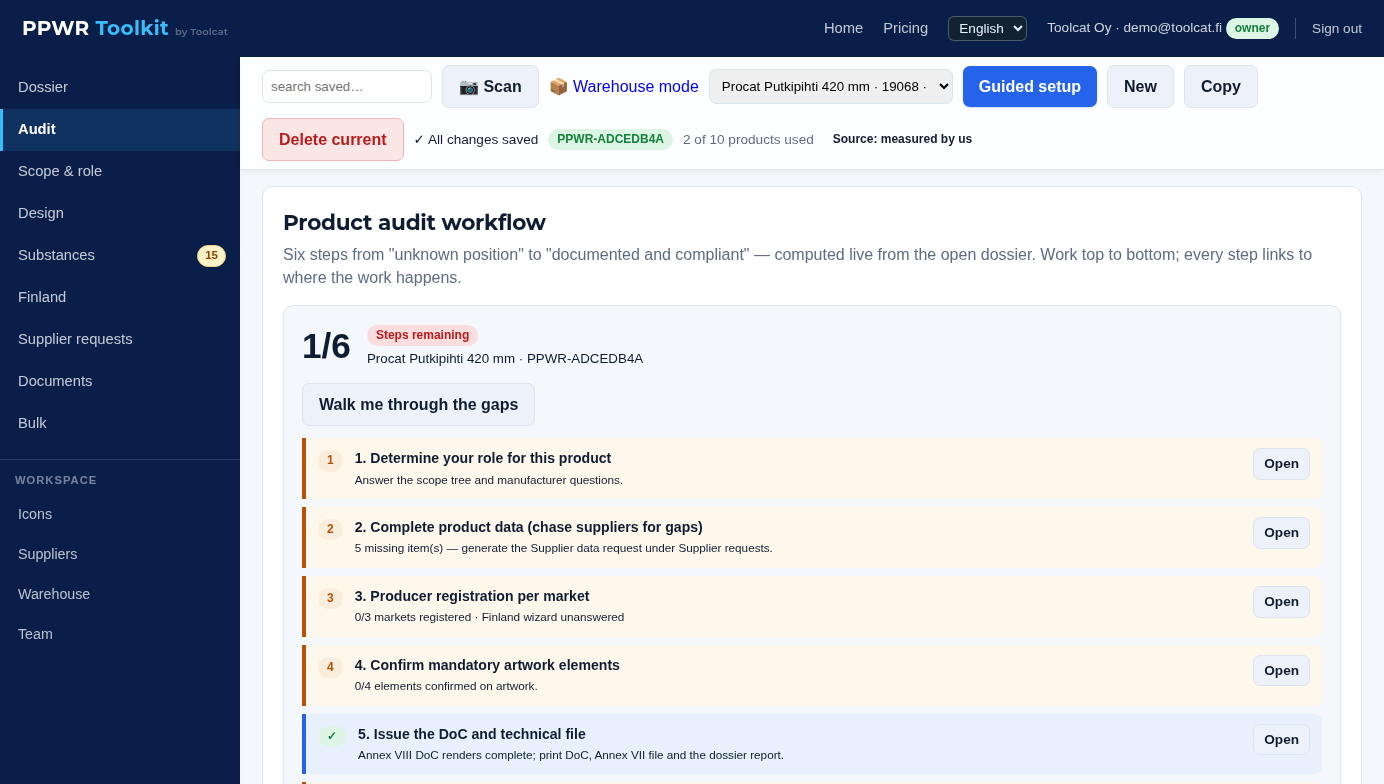
- Role, data gaps, registrations, artwork, documents, evidence — in that order.
- Each step links to where the work is done and names what is missing.
- An artwork checklist per market. It keeps law apart from convention.
- Catalogue overview: every saved product against all six steps. Filter by the step that is still open.
- Apply scope and role answers across the whole catalogue in one action.
Scope and economic-operator role
Who owes what under Arts 15 to 22 and 44 to 45 — the question that decides everything downstream. PPWR for small businesses and micro-enterprises.
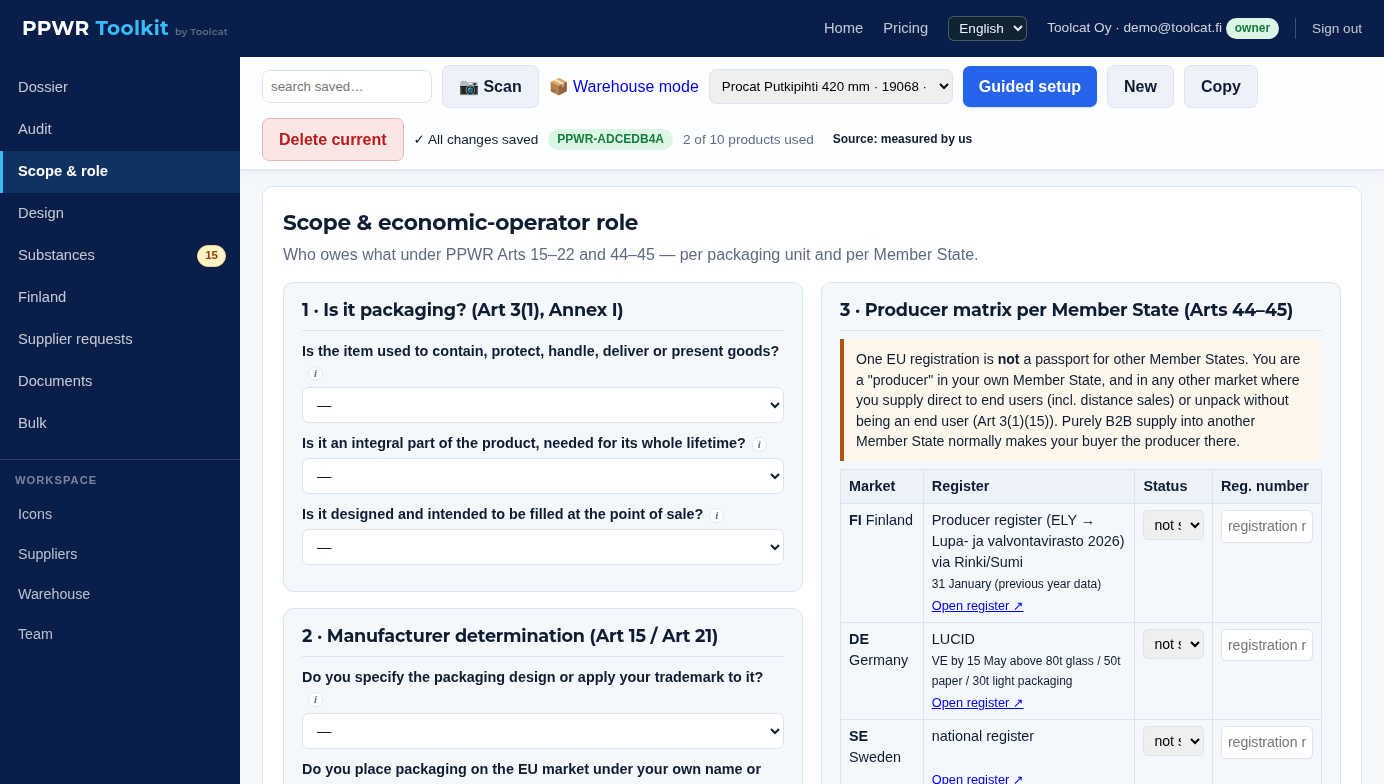
- Is it packaging? The Art 3(1) decision tree with the integral-part and service-packaging branches.
- Who is the manufacturer, including the Art 21 trap. Rebrand the packaging, or modify it in a way that could affect its compliance, and you become the manufacturer.
- Are you a micro-enterprise with a packaging supplier in the EU? Then the supplier, not you, carries the manufacturer's Art 15 duties (Art 15(12); Art 21 for rebranding importers and distributors). A micro-enterprise has fewer than 10 staff, counted as annual work units, and at most EUR 2 million turnover or balance sheet. Count any partner or linked enterprise in that total (Recommendation 2003/361/EC). A supplier outside the EU never triggers it: an own-brand importer buying from China is the manufacturer with the full Art 15 duties. The shift moves the paperwork, not the requirements. Arts 5 to 12 still bind the packaging. It does not move producer registration or fees either (Art 3(1)(15), Arts 44-45). What the PPWR asks of a small business.
- Producer matrix per Member State with register names, deadlines and registration tracking.
- Reference card for the Art 3(1)(12) economic-operator roles and their duties. It covers the EPR (extended producer responsibility: the producer pays for collecting and recycling its packaging) producer role as well.
- Arts 28 to 33 re-use, HORECA (accommodation and food service, Art 3(1)(35)) and refill questions, with the Annex VI re-use loop type.
- Art 19(2)(a) register-check log for the distributor role. It records who looked the producer up, and on what day.
Design compliance: recyclability, empty space and minimisation (Arts 6, 10, 24)
Arts 6, 7, 10, 11, 24 and 25 with numbers you can act on rather than a red or green light.
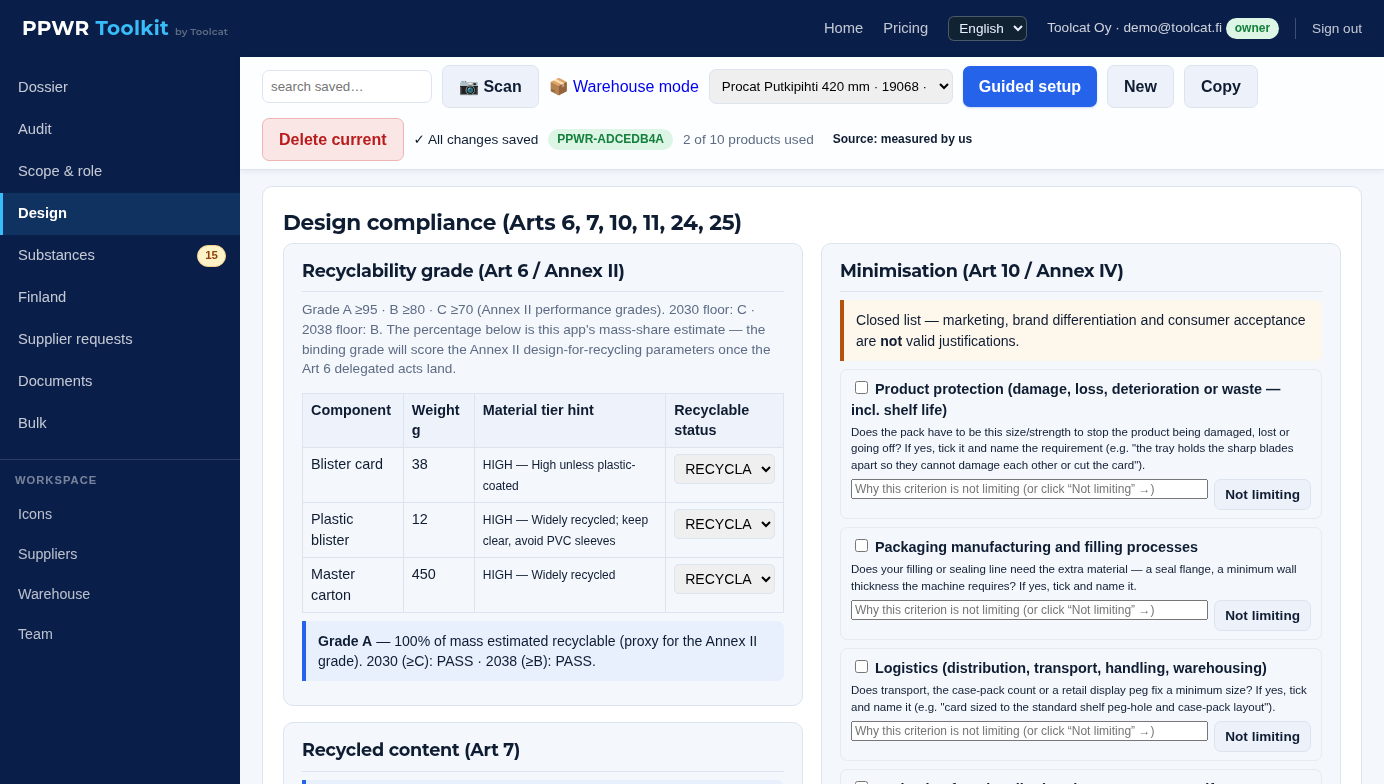
- Annex II recyclability grading with a transparent mass-share estimate. You see the 2030 and 2038 verdicts and the gap to the next grade in grams. The grade stays marked provisional until the delegated acts define the weighted design score.
- Art 7 recycled content across the four categories. The app applies the sub-5 % component exemption for you.
- SUP (single-use plastics, Directive (EU) 2019/904) rPET planning average, tonnage-weighted across bottle lines. Directive (EU) 2019/904 Art 6(5) itself binds Member States on a market-wide average.
- Art 10 minimisation against the closed Annex IV list. A red-flag self-check covers double walls and false bottoms.
- Annex V banned-format screen from 2030, with each row's statutory exclusions spelled out.
- Art 14 environmental-claims check. Every claim names its referent, and its substantiation goes in the Annex VII file.
Substances (Art 5)
The part where guessing is most expensive. Absence of data is never a pass here: the Art 5 limits that apply from 12 August 2026.
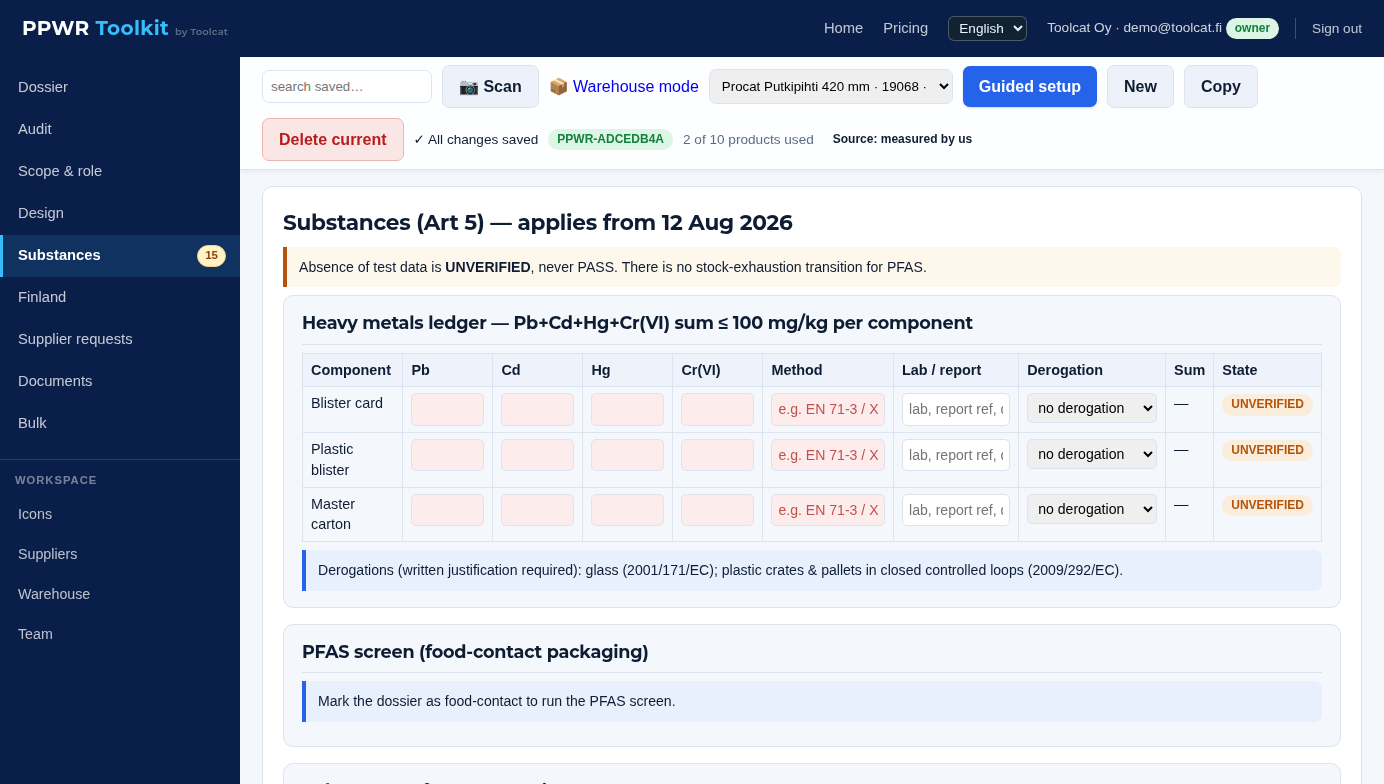
- Heavy-metals ledger per component against the Art 5(4) 100 mg/kg sum. Record the method and the laboratory with it.
- Stepwise PFAS (per- and polyfluorinated alkyl substances, often called forever chemicals) screen for food contact. It reads the 25 µg/kg, 250 µg/kg and 50 mg/kg limits, breached at the limit value itself. It adds the 50 mg/kg total-fluorine speciation trigger, with no safe harbour below it.
- No stock-exhaustion transition for PFAS — flagged, because it catches people out.
- Substances-of-concern register for REACH (Regulation (EC) No 1907/2006) candidate-list declarations.
- Derogations named where they exist: glass, and plastic crates and pallets in closed loops.
Finland: producer responsibility, fees and Palpa
The national layer that the EU tools ignore — computed, not described.
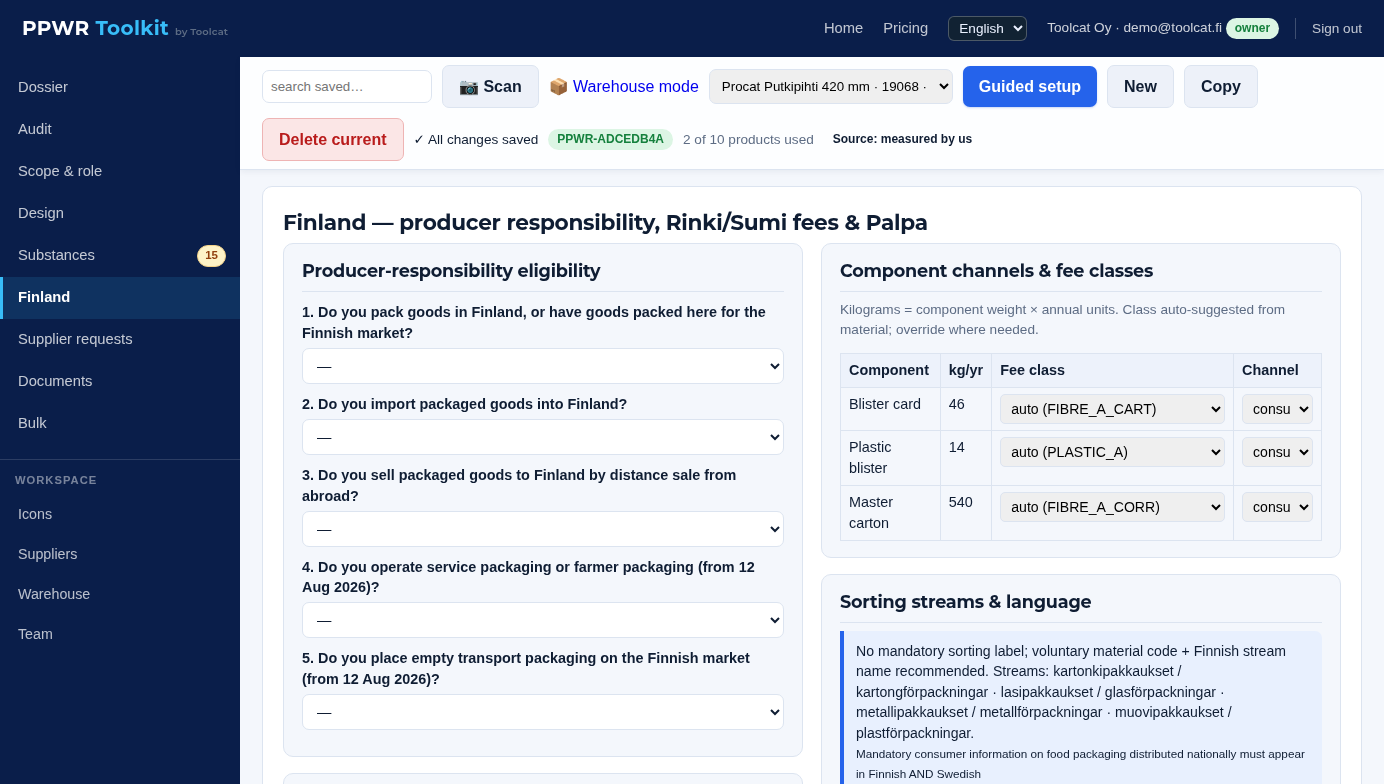
- Eligibility wizard covering both widenings of the producer definition. Service and primary-production packaging came in on 1 January 2024 under jätelaki 646/2011 § 48. Transport packaging comes in on 12 August 2026 under the PPWR.
- Route selection: Suomen Pakkaustuottajat via Rinki, Sumi, own registration, or the Åland contract.
- Fee calculator on the published Sumi 2026 and SPT (Suomen Pakkaustuottajat Oy) 2026 per-kilo lists, split by consumer and business channel. The SPT 2025 list stays in place for earlier reporting periods.
- Clamped annual service fee, VAT at 0 % and 25.5 %, and eligibility for the light (kevyt) or detailed (tarkka) reporting form.
- Late-filing and laiminlyöntimaksu (neglect fee) exposure alongside the actual cost of complying.
- Annual reporting: one record per filing period over the whole catalogue, totals in the Rinki/Sumi taxonomy, a Rinki-compatible CSV. Units come from your ERP (enterprise resource planning) export: the sales figures from your stock or invoicing system.
- Palpa: deposit by container and volume, reverse-vending geometry, barcode and mark sizes, beverage-tax comparison.
National producer responsibility: Finland and eleven more markets
Producer registration, fees and annual reports for FI, SE, EE, DK, DE, NL, PL, AT, BE, ES, FR and IT. The app computes each one from that market's own national law and price list.
- The producer test per market: who registers, and on which route. A collective scheme, or your own registration. The answer comes from that market's own law, never from the conformity role.
- The register per market, by name: LUCID (Germany), PAKIS (Estonia), Naturvårdsverket's producer register (Sweden), Producentregistret (Denmark), RPP (Spain), SYDEREP (France), BDO (Poland). Austria has two: EDM (Elektronisches Datenmanagement Umwelt) and the VKS (Verpackungskoordinierungsstelle) list of system participants.
- Belgium, Italy and the Netherlands have no producer register yet. The module says so and names the operative act instead. That act is the Fost Plus and Valipac declarations and EPRiBEL, membership of CONAI (Consorzio Nazionale Imballaggi), or membership of Verpact.
- A fee estimate on each scheme's published price list. The module shows its confidence level for the gate, the fees, the reporting, the deposit rule and the penalties.
- The reporting rhythm per market: annual, quarterly or monthly, to the scheme and to the authority. You get its deadlines and the material taxonomy each one uses.
- Two documents per market, built from the same dossier: the packaging data sheet and the annual producer report.
- Fee figures are estimates from the published price lists, never amounts owed or filings.
| Market | Register | Law the module reads |
|---|---|---|
| Finland | The producer register at Lupa- ja valvontavirasto; producer communities Suomen Pakkaustuottajat (via Rinki) and Sumi | Jätelaki 646/2011, VNA 1029/2021 |
| Austria | EDM (Elektronisches Datenmanagement Umwelt) and the VKS list of system participants | AWG 2002, VerpackVO 2014 |
| Belgium | No producer register yet: annual declarations to Fost Plus and Valipac, information return to EPRiBEL | Samenwerkingsakkoord of 4 November 2008 and of 9 February 2026 |
| Denmark | Producentregistret | Emballagebekendtgørelsen |
| Estonia | Pakendiregister (PAKIS) | Pakendiseadus |
| France | SYDEREP (ADEME) | Code de l'environnement, art. L. 541-10 |
| Germany | Verpackungsregister LUCID | VerpackDG, in force 12 August 2026 |
| Italy | No packaging producer register: the operative act is joining CONAI | D.Lgs. 152/2006, Parte IV |
| Netherlands | No producer-facing register yet: the operative act is joining Verpact | Besluit beheer verpakkingen 2014, Besluit UPV |
| Poland | BDO (Baza danych o produktach i opakowaniach oraz o gospodarce odpadami) | Ustawa o gospodarce opakowaniami i odpadami opakowaniowymi (2013) |
| Spain | Registro de Productores de Producto (RPP), sección envases | Real Decreto 1055/2022 |
| Sweden | Naturvårdsverkets producentansvarsregister | Förordning (2022:1274) om producentansvar för förpackningar |
Documents
More than thirty document types generated from the dossier, downloadable as a real PDF, or printed from the browser. File the signed declaration and every test report or certificate against its evidence record.
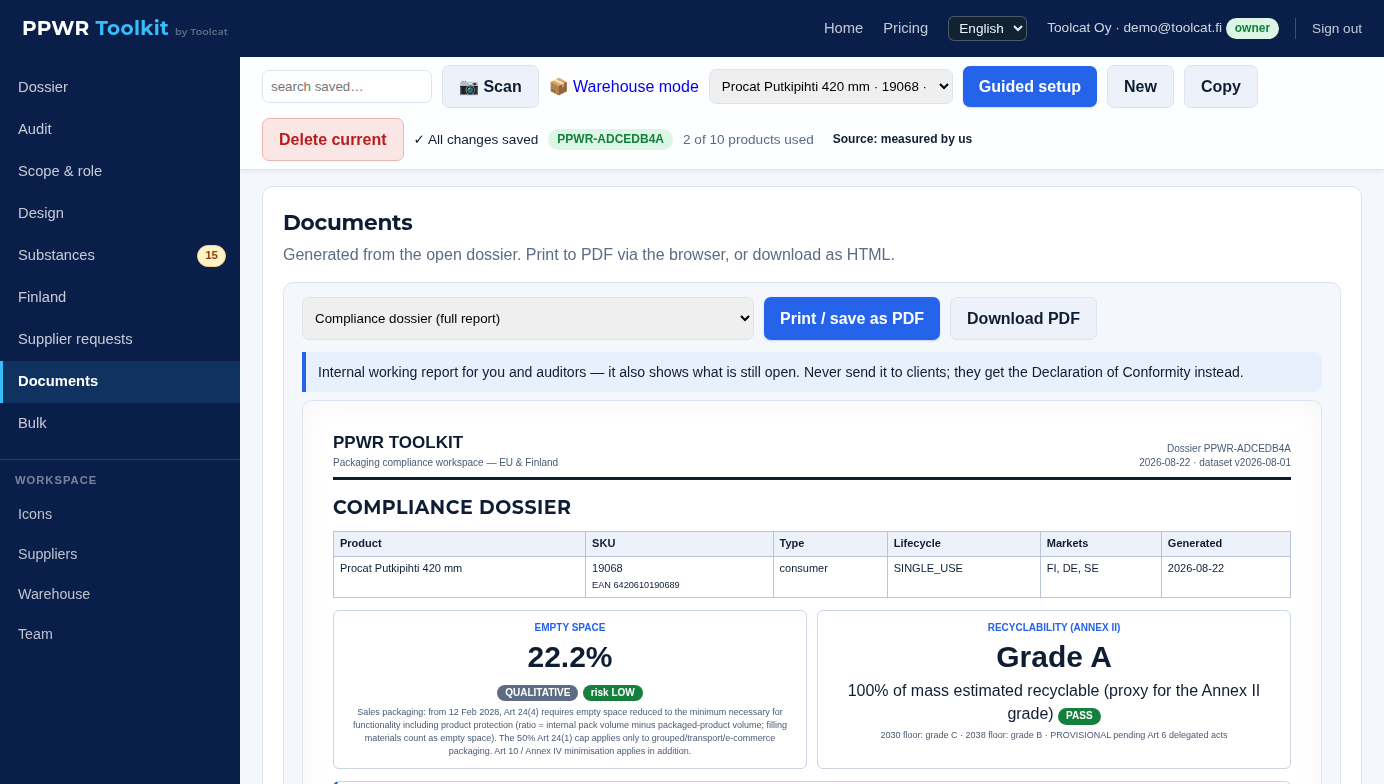
- Annex VIII declaration of conformity: the model's eight points plus the signature block. A validator refuses to render an incomplete one.
- Annex VII technical documentation: the six required elements (a)-(f) plus extra evidence sections. Gap badges show where evidence is thin.
- Full compliance dossier report, stamped with the dossier reference and dataset version.
- Supplier data request under Art 16, listing exactly what is missing.
- Pre-filled supplier compliance declaration for signature, and a one-click file into the evidence register.
- Finland packaging data sheet, Palpa readiness spec, artwork elements card and consumer disposal sheet with QR.
- National on-pack labelling pack: every target market on one page. It gives you the wording where you may compose it, and the request where you may not.
- France Triman and Info-tri artwork brief, and the Italy environmental labelling artwork itself.
- Deposit and scheme mark request, carrying each operator's print constraints.
- Material identification document. Plus the Art 55 end-user information page, which your public product page carries automatically.
- Art 45(7) EPR self-certification for marketplaces and fulfilment providers.
- Art 28 rules-for-refill notice for the point of sale, and the Annex VI re-use data sheet (Arts 30-31).
- Distributor compliance request for brands you resell. Ask for a copy of the brand owner's declaration, its producer registration number and a marking confirmation.
- Recycled-content (PCR) worksheet per supplier and material, and the PCR declaration for signature.
- Per-country packaging data sheet and annual producer report for the twelve markets.
- Client confirmation letter with a verification link — see below.
- Public product page per product, at /p/ followed by your publish token and the EAN or SKU. It always carries the Art 55 consumer information and the per-market sorting information. The declaration of conformity appears only where you opt in and it validates. The technical file and supplier documents are never published. Disabling publishing kills every link.
- WooCommerce link sync writes each product's public page link into your store once a day, matched by SKU or EAN.
Give documents to your customers
A per-customer confirmation letter. It lists your products and the status of each declaration of conformity. It is not a certificate, and it is not the Annex VIII declaration itself.
- A client registry: name, customer number, email and letter language — Finnish, Swedish or English.
- The service records each approval on the server, with a document ID and an approval log. It stamps a SHA-256 fingerprint on the page. SHA: a secure hash algorithm, so the same file always gives the same short code.
- A public verification page per letter, at /l/ followed by its token. It recomputes the fingerprint, so the recipient can check that the paper they hold is the letter that was approved.
- PDF download, and the option to attach the product's signed declaration of conformity.
- Sent from the app, or opened as a draft in your own mail program.
Supplier portal
One page your supplier can actually fill in: no account, no spreadsheet round-trip. A private link shows exactly what is missing on the products they ship you, and explains every field in plain words.
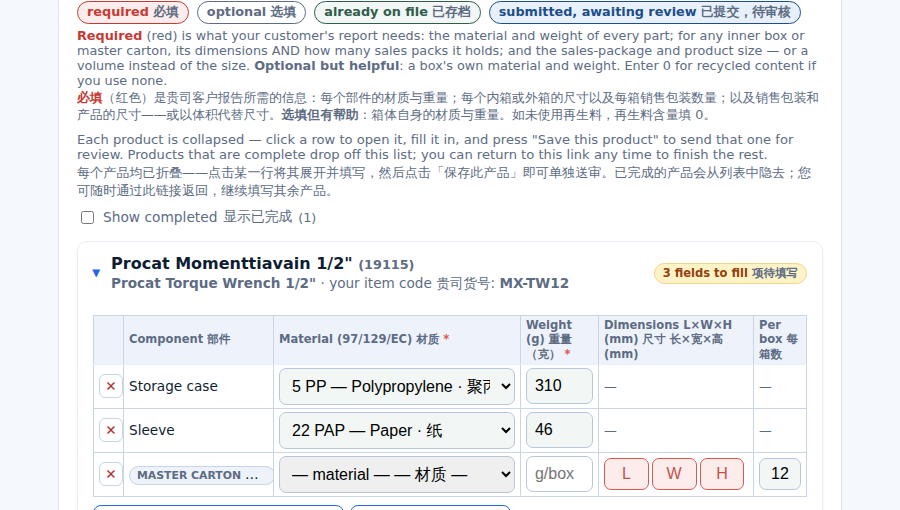
- No account and no new software: the supplier opens one link in a browser and starts typing. A link can carry a password where the data is sensitive, and you can switch it off without losing the address.
- Six languages: English, Chinese, Finnish, Swedish, Polish and German. An English-plus-Chinese mode puts both on the same page, so the factory and your buyer read the same sentence.
- Four portal types. A single factory fills in packaging data. A trading agent names the factory behind each product. A brand owner you only resell uploads its declaration of conformity and registration number. A brand owner that is the producer in your market supplies the declaration plus its producer-responsibility data.
- Every field explained in plain words: which part to weigh, what a sales unit is, why the figure is needed. Nobody has to have read the regulation to answer it.
- Partial saves survive. A supplier saves one product, closes the tab and comes back for the rest. Finished products drop off the list. Anything already on file arrives pre-filled and marked as such.
- Upload slots for the signed papers: the compliance declaration, the recycled-content declaration, the test report. Each one files against the product it belongs to.
- Nothing enters your data unchecked. Every answer arrives as a submission, with the changed values highlighted. You review and accept it before it touches the dossier.
- A supplier can turn its portal link into a free workspace of its own: Register to manage your documents sits beside Continue without registering. The link keeps working either way.
One-click supplier requests
The toolkit already knows which documents and figures each product is missing. It generates the request papers and writes the whole email — subject, body, the portal link — in the supplier's language.
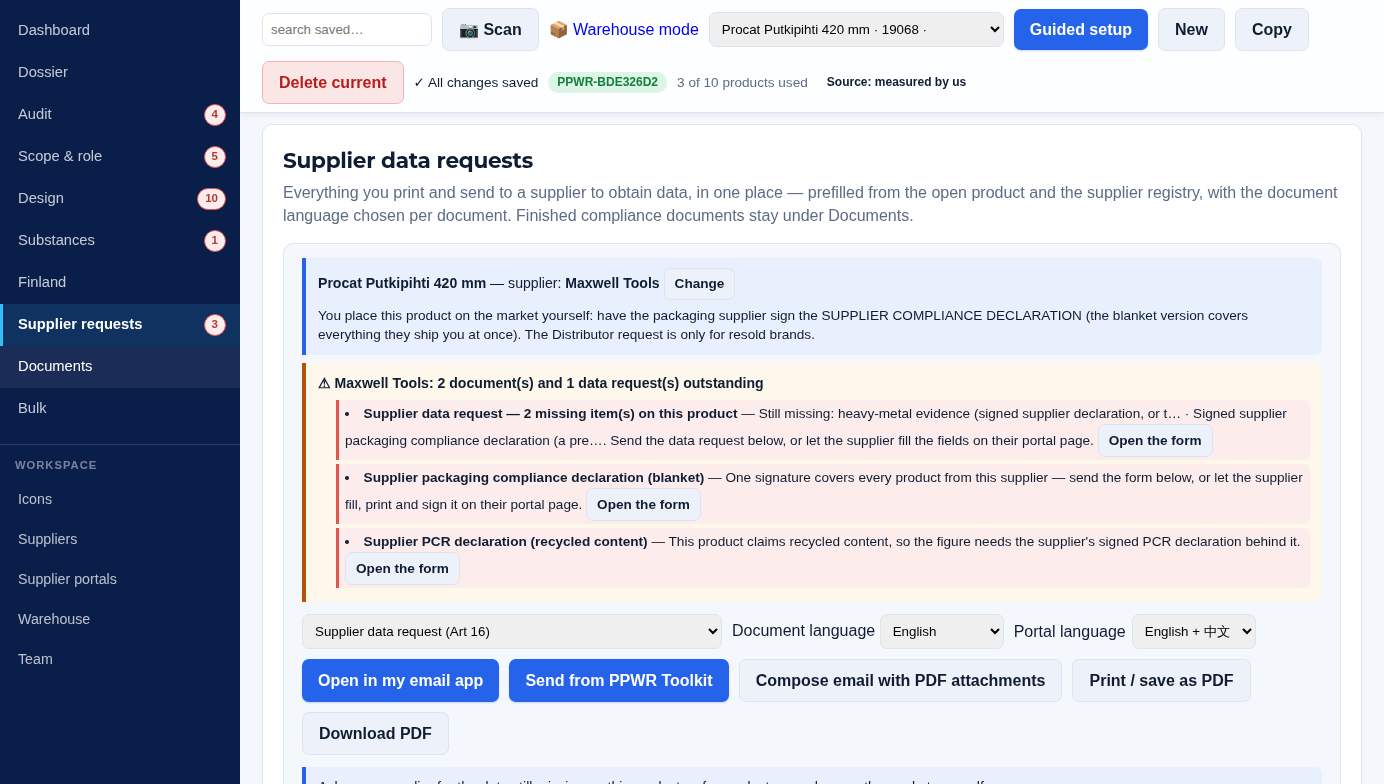
- The toolkit computes the missing list. You never type it. It names the documents outstanding and the figures still empty for this product and this supplier, before you send anything.
- The papers come pre-filled: the Art 16 data request, the supplier packaging compliance declaration, the recycled-content declaration. Each one is ready for signature and stamp.
- The email is written for you: subject, body, what you need and why, the supplier's own portal link and its password. One click opens it ready to send from your mail app, or straight from the service.
- Attachments or a link, your choice. Send the PDFs with the mail, or send the portal link and let the supplier answer online. It is the same request either way.
- One signature can cover a whole supplier. The blanket compliance declaration covers everything they ship you, so you do not chase the same factory once per SKU.
- What comes back lands on the product it belongs to. The moment you accept it, the app recomputes the readiness of every product it touches.
- A supplier registry: who ships what, which declarations are on file and until when, agents mapped to their factories, and brand-to-supplier mapping so a feed import lands on the right supplier.
The whole supply chain, in one chain
Every workspace says at signup where it sits in the chain: factory, wholesaler or retailer, or more than one. The wholesaler runs the chain. Its factories answer its requests in a free workspace of their own. Its retailers read its ready documents in a free library.
- You run the chain as the wholesaler: the importer, brand owner or distributor that buys from factories and sells to retailers. On Pro and above, your Supply chain tab links your factories upstream and your retailers downstream. Your factories and retailers never pay.
- One side proposes a link, with the partner's chain code or by email. The other side confirms it. Nothing is shared before that, and either side can revoke the link at any time. A factory never sees your retailers, and a retailer never sees your factories.
- Send a linked factory a typed document request for one product. Your retailers see each product's status as your own dashboard shows it, marked as declared by you.
- A factory gets a free workspace of its own. It registers from the portal link its customer sent, or signs up with the factory role. Its My customers page lists each customer's products that name it, and what the customer still asks for. Everything it sends lands in the customer's review queue, exactly as through the portal, and the customer accepts or rejects it.
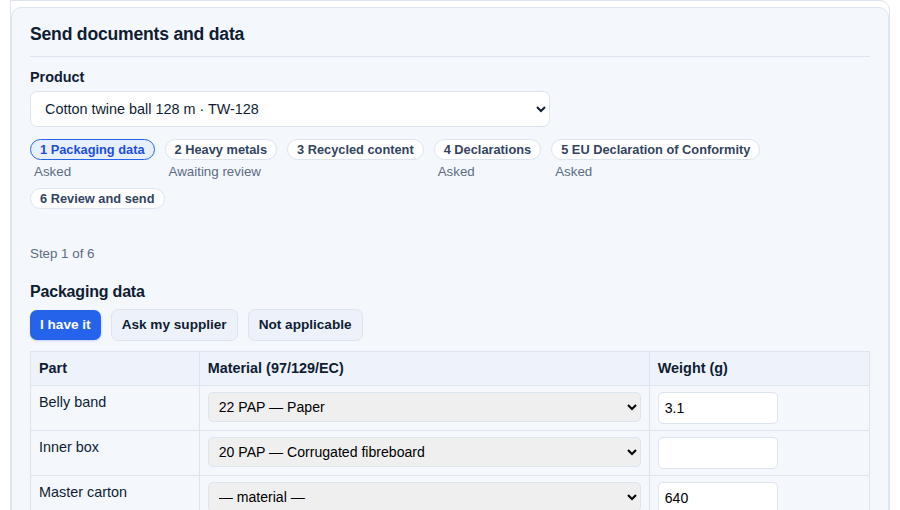
- A six-step wizard per product: packaging data, heavy metals, recycled content, declarations, the EU Declaration of Conformity and confirmations, then review and send. The first five steps each offer I have it or Not applicable, and the first three also Ask my supplier. The declarations step downloads the pre-filled blanket supplier declaration to sign and upload.
- Ask my supplier writes request letters to the factory's own packaging maker, printer or ink supplier, built from the customer's product and its parts, in English, Chinese, Finnish, Swedish or German. The letter never names the customer. It asks for a heavy-metals statement and lists the papers the maker may already hold: a Directive 94/62/EC Art 11 report, a US CONEG report, an EuPIA statement for inks, a report from an ISO/IEC 17025 laboratory. A signed statement on the maker's letterhead is enough on its own.
- The factory's free plan holds up to 25 products of its own once a link with a customer is confirmed, and none before. The national producer-responsibility modules are not part of it. A factory can link its own packaging suppliers above it, too.
- A retailer gets a free, read-only library. For every confirmed wholesaler: the products with the wholesaler's traffic light as declared by it, the EU Declarations of Conformity the wholesaler signed, the Art 55 consumer information and the label pack, the producer-registration numbers per market, the marking confirmation and the public product page. It sends typed document requests back, and creates no products of its own.
- The supplier portal keeps working as before: one link, no account. A supplier that never registers loses nothing.
- A two-page PPWR 101 for suppliers in English, Chinese, Finnish, Swedish, Polish and German, at ppwrtoolkit.fi/ppwr-101: what the customer needs, which papers count, what to ask the material makers. Every portal page and every invitation links to it in the supplier's language.
Team and roles
Compliance work is rarely one person's job. Every plan carries unlimited team members in one workspace, and four roles decide what each of them can reach.
- Unlimited accounts on every plan, the free trial included. People are not a price dimension, so nobody has to share a login.
- Four roles. The owner manages administrators and the subscription. Administrators run the workspace. Members do the compliance work. Warehouse accounts only look up products and update packaging data.
- An owner or administrator creates the account. The service shows a one-time temporary password once. The person changes it at first sign-in. No email invitations to chase.
- Owners and administrators read the audit log: every sign-in, dossier change and account change, with who did it and when.
- One workspace, one dossier per product. Everyone reads the same traffic light: green passes, amber is declared and awaiting evidence, red is a gap.
Warehouse mode
The measuring is done by the people who handle the goods, on the phone in their pocket. A separate scan-first screen at /warehouse gives them one job: scan a product, complete its packaging data, move on.
- Scan the EAN with the phone camera, use a Bluetooth scanner, or type the EAN or SKU. An unknown code is a dead end: a warehouse account cannot create products.
- The same traffic light as the app and the supplier portal, from the same completeness engine. Green means the packaging data is complete. Amber lists what is still missing.
- What amber asks for: each component with its name, material code and weight in grams. Then the inner pack and master carton rows, and the units per inner pack and per master carton. A per-row weight calculator and an optional packaging photo come with it.
- A warehouse account can write only components and pack quantities. The server strips out company details, markets, substances, suppliers, evidence, documents and the Finland data. None of it reaches the device.
- The app stamps your measurements as measured in-house, not declared by a supplier. Every update lands in the audit log.
- No scanner needed for a weighing session. Fill missing weights walks the products that still lack a component weight, one by one. Save, and the next one appears.
- The capture screen runs in English and Finnish.
National labelling across the EU-27 and the UK
The toolkit draws a label where the law lets you compose it. It writes a request where the mark belongs to a scheme. It never guesses which is which. It reads every market from that market's own rule.
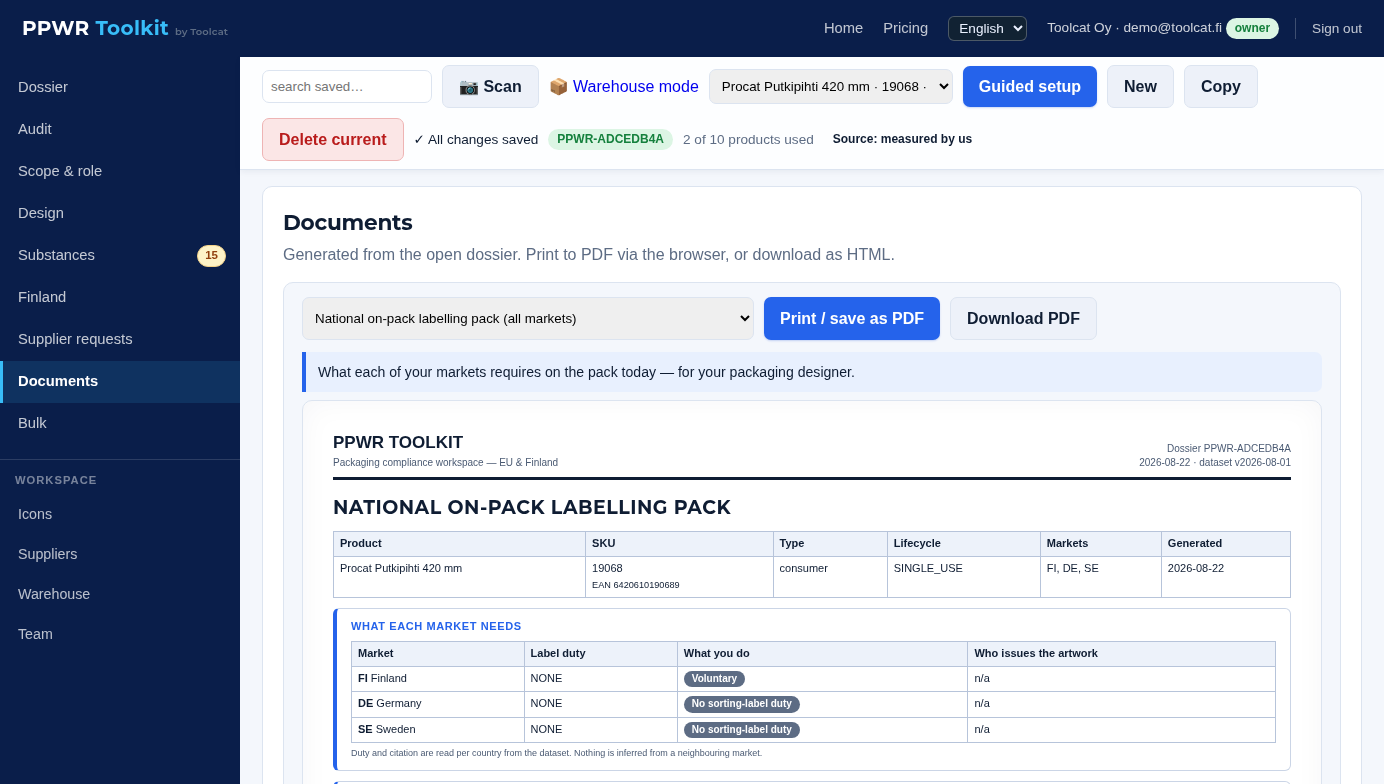
- Italy: alphanumeric code plus collection family, generated per component. You get print-ready blocks and plain text for the studio. Transport packaging correctly drops the family line.
- Spain: the disposal fraction per component, with the reminder that the container pictograms belong to Ecoembes.
- France: the full Triman and Info-tri request. It carries your ADEME (Agence de la transition écologique) identifiant unique and the per-part bin wording to confirm.
- Deposit marks: DPG (Deutsche Pfandsystem GmbH), Palpa, Pant, Statiegeld, Re-turn and the rest. The request names the operator and carries their print constraints.
- Composites, wood and textiles are marked "ask your scheme" rather than assigned a bin that might be wrong.
- Finland's rows carry the Swedish stream name alongside the Finnish.
Guided setup
One continuous flow over every field in the dossier, with no tab-hopping. Plain language above each control explains the question. The person filling a field in for the first time is exactly the person who does not yet know what it means.
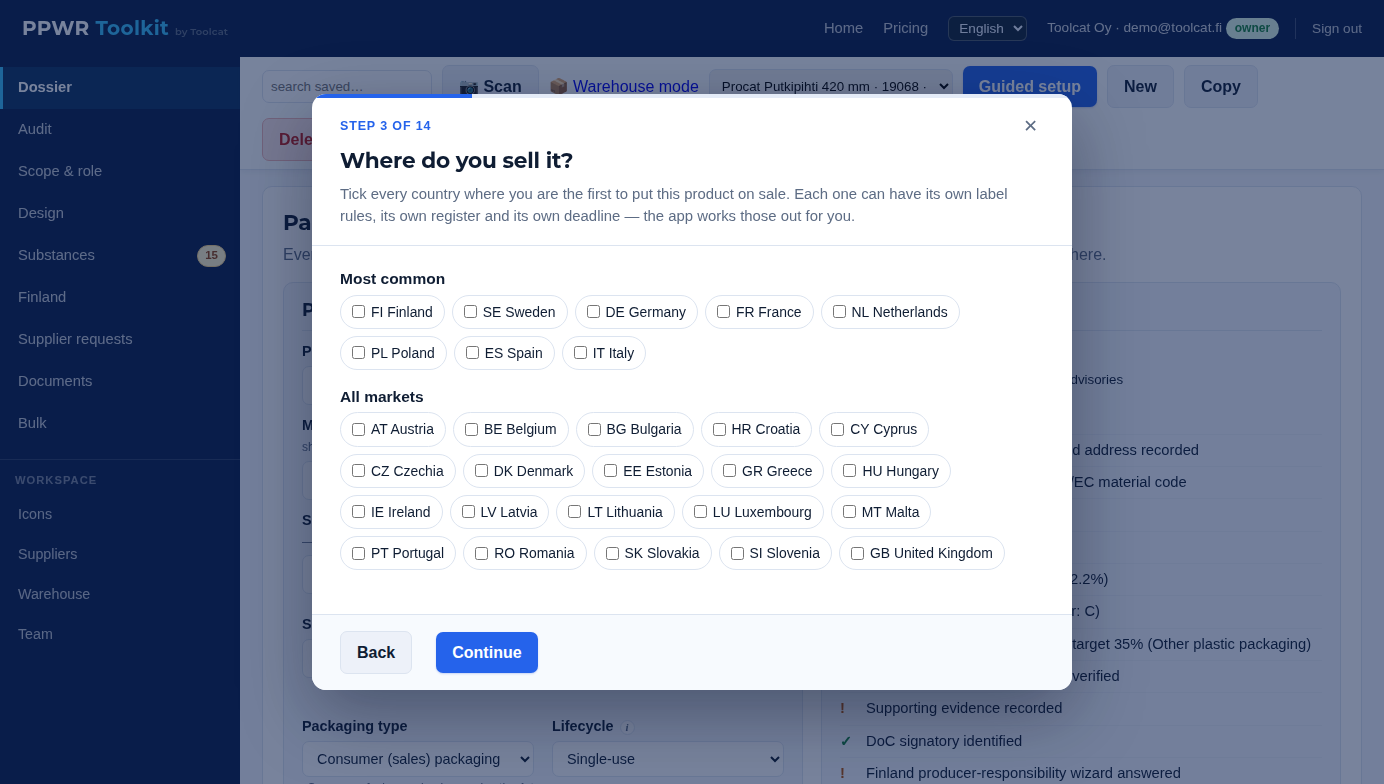
- The flow adapts. A drink adds the deposit and Palpa steps. Food contact adds PFAS. Finland adds producer responsibility. Reusable packaging adds the Art 11 criteria.
- A plain product with one market sees 16 steps. A Finnish beverage sees 19. A reseller that only verifies sees 11.
- Feedback is live. The recyclability grade appears as you enter the weights. The deposit verdict appears as you describe the container.
- Heavy metals offer the shortcut importers actually use. Choose a signed supplier statement and the supplier request asks for it. Art 5 counts as documented once the signed copy is filed in the evidence register.
- The last step scores all six audit steps and lists what is still open.
Bulk and scale
Built on the assumption that you have hundreds of products, not one.
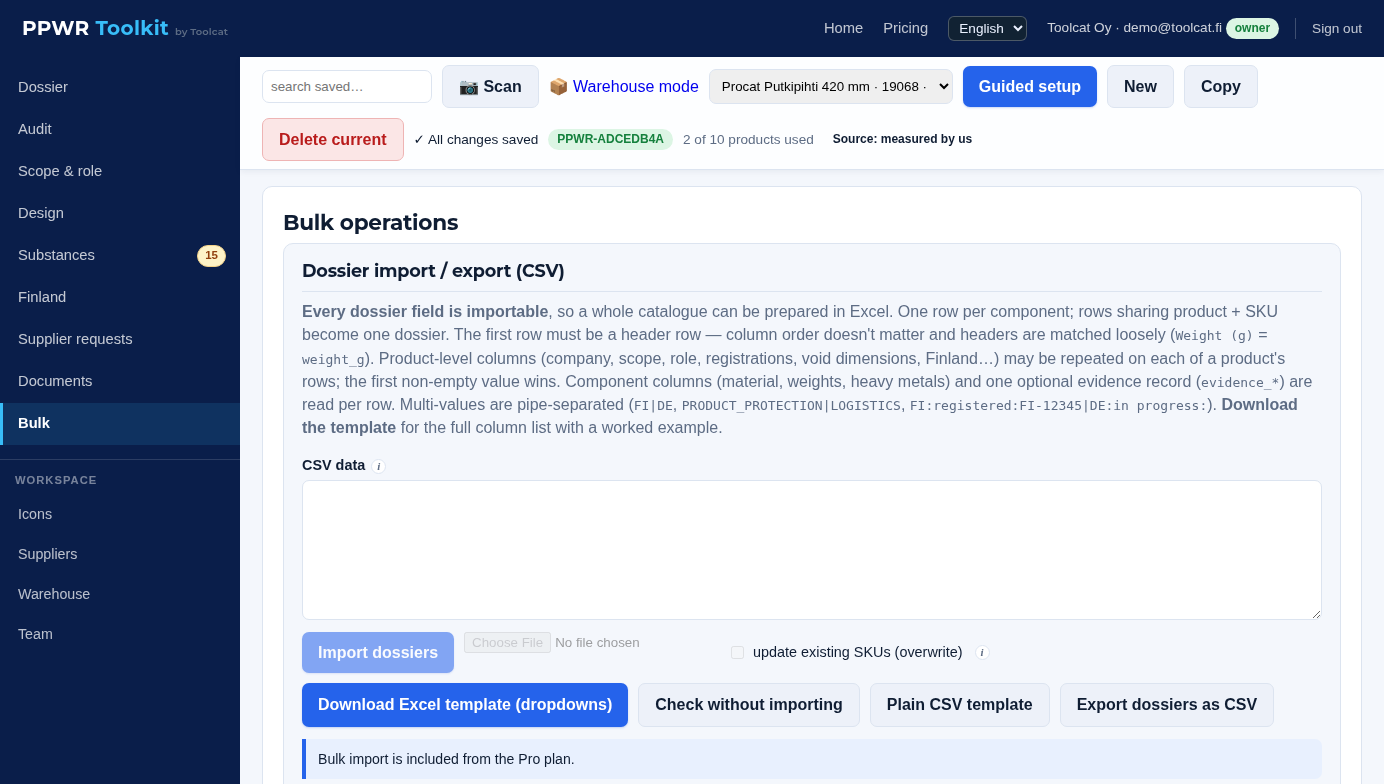
- Excel template with real dropdowns on every field that has a fixed set of values.
- Every dossier field importable — over 300 columns, one row per component, merged by product and SKU.
- Validated before anything is written: one bad cell rejects the sheet, naming the row and column.
- Round-trip export, enrich in Excel, re-import with overwrite.
- Catalogue audit overview with search, market and open-step filters, cached scoring and pagination.
- A full backup of your workspace as a .zip: the data plus every file you uploaded. Download it, or have it emailed to you every week. A JSON data export is there too, and the import takes either file.
Things that matter once you depend on it
Your data stays yours
A small self-contained service with no third-party runtime dependencies. No analytics, no external fonts, no CDN (content delivery network). You can download a full backup of your workspace as a .zip: the data plus every file you uploaded. A JSON data export is there too.
Multi-user with an audit trail
Organisations, with the owner, administrator, member and warehouse roles. Session-based sign-in with rate limiting. A log of every sign-in, dossier change and account change.
Versioned regulatory data
The datasets sit apart from the code. Every document carries their version stamp, so an audit can tell which snapshot a decision was made against.
English, Finnish, Swedish and German
The whole product, not just the menus: engine verdicts, reference data and every generated document, switchable per user.
Provisional means provisional
Some figures depend on Commission acts that are not yet in force: delegated and implementing acts for the recyclability grade, implementing acts for the recycled-content and empty-space calculations. The app labels each one as provisional and names the act it waits on, rather than showing it as settled.
Adversarially reviewed
A structured security campaign has gone through the application. It covered authentication, tenant isolation, CSRF (cross-site request forgery) and input validation. Most usefully, it asked whether the compliance verdicts themselves can be wrong. Internal structured campaign, 7 rounds, last run on 25 August 2026. Report a vulnerability via security.txt.
Try it on your own catalogue.
Fourteen days free, five products, no credit card. Add your products and see where every one stands.