Finland is where this toolkit goes deepest.
Finnish packaging producer responsibility: who is a producer, where to register, what it costs
Last reviewed · Dataset v2026-10-03 · Reviewed by Pauli Parkkinen, General Manager, Toolcat Oy
Finland's packaging EPR (extended producer responsibility: the producer pays for collecting and recycling its packaging) rests on jätelaki 646/2011, the Finnish Waste Act. From 12 August 2026 the PPWR (Regulation (EU) 2025/40, the Packaging and Packaging Waste Regulation) applies on top of it. This page covers the professional-operator gate, the registration routes, the per-kilo fees, the two deadlines that people confuse, and the annual report itself.
What Finnish law requires
Packaging producer responsibility in Finland rests on jätelaki 646/2011 § 48 and VNA 1029/2021, alongside the PPWR. VNA is the Valtioneuvoston asetus pakkauksista ja pakkausjätteistä, the Government Decree on packaging and packaging waste. The gate is professional operation, not turnover. Act 1096/2022 removed the EUR 1 000 000 turnover threshold with effect from 1 January 2024. From the same date the producer of service packaging and primary-production packaging is the manufacturer or importer of that packaging (jätelaki § 48). The ELY Centres (ELY: the regional state authorities) estimated that the two changes together brought 20 000 to 30 000 further companies into scope.
From 12 August 2026 jätelaki § 48(1) item 6 defines the packaging producer by reference to PPWR Art 3(1)(15) (act 648/2026). In practice producer responsibility for transport packaging moves from the packer to the packaging manufacturer or importer. The register itself moved from Pirkanmaan ELY-keskus to Lupa- ja valvontavirasto on 1 January 2026. Tukes is the market-surveillance authority for packaging requirements under jätelaki § 24 a, a role it already held before the PPWR applied. From 12 August 2026 that covers PPWR Arts 5, 6, 8-12, 14 and 24-26 and the Art 7 recycled-content minimums for other plastic packaging (VNA 1029/2021 § 23). The Art 7 minimums for contact-sensitive packaging and single-use plastic beverage bottles go to the food-control authorities (jätelaki § 24 a(4)). Every Finnish and EU date is on the PPWR compliance timeline.
Sources: jätelaki 646/2011, Lupa- ja valvontavirasto on the PPWR producer definition, ELY Centres on the 1 January 2024 change, Tukes.
The Suomi module: producer responsibility, computed
The gate, the routes, the destination test and the fee engine: the Finnish layer the EU tools ignore. Computed per product from data the dossier already holds.
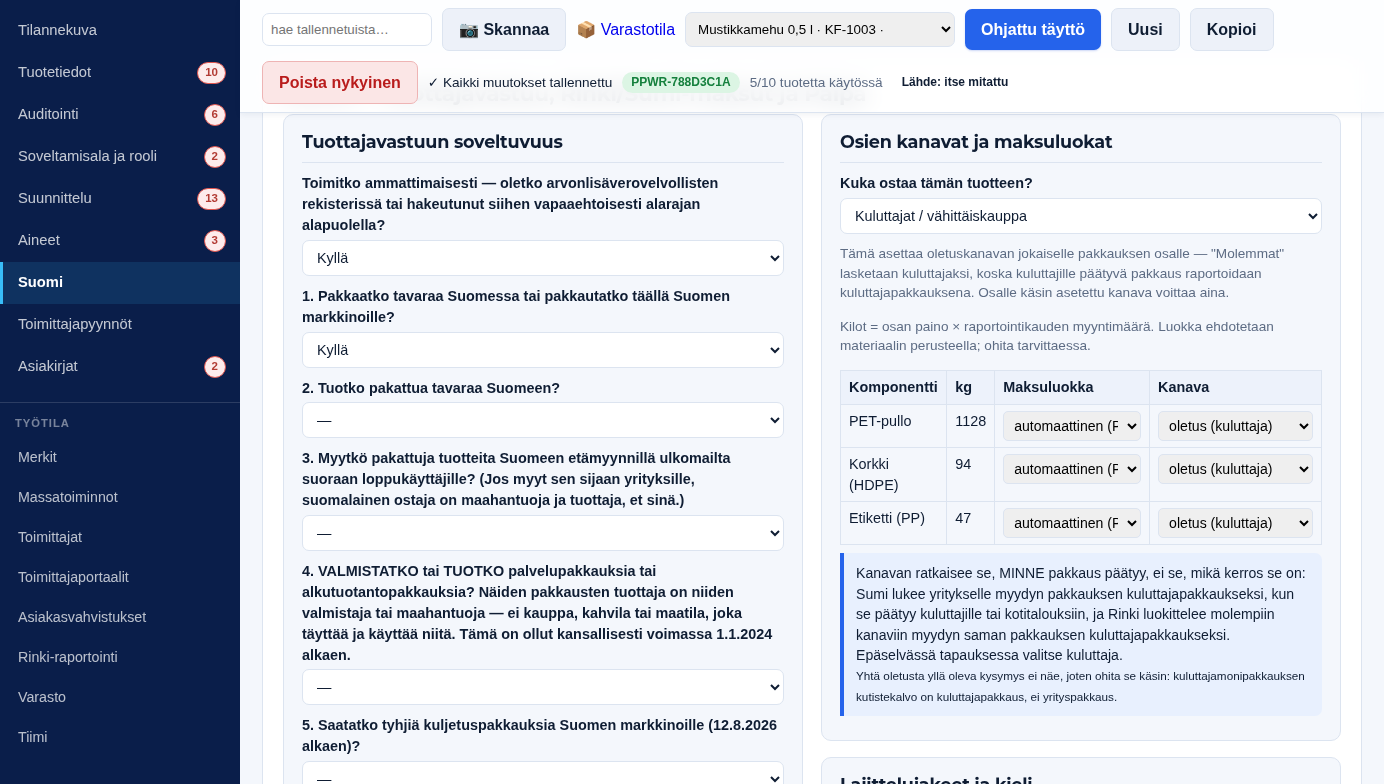
- The app asks the professional-operator gate first: no gate, no producer status. A report for an earlier year gets the rule that was in force that year, not today's.
- Registration routes as they really are: a producer community via the Rinki service or Sumi, own registration as the authority-granted exception it is, and the separate Åland contract.
- Consumer or business fee channel, resolved per packaging part by the destination test: where the packaging ends up, not who you invoice. Defaults show as defaults, and you override by hand.
- The per-kilo fee engine prices on the operators' published price lists: Suomen Pakkaustuottajat and Sumi, detailed and light forms. It prices to the cent, with VAT at 0% and 25.5% and the clamped annual service fee.
- Both deadlines, kept apart: packaging data to your producer community by 31 January. Then the statutory end-of-June return to Lupa- ja valvontavirasto, which the community files for its members.
- A per-product period history: every reporting period that counted this product, with its units, kilograms and fee. Filed figures show as filed.
The Rinki module: the annual report as records, not a scramble
One record per filing period over the whole catalogue. A year is not always one period, and the figures you filed must keep saying what you filed.
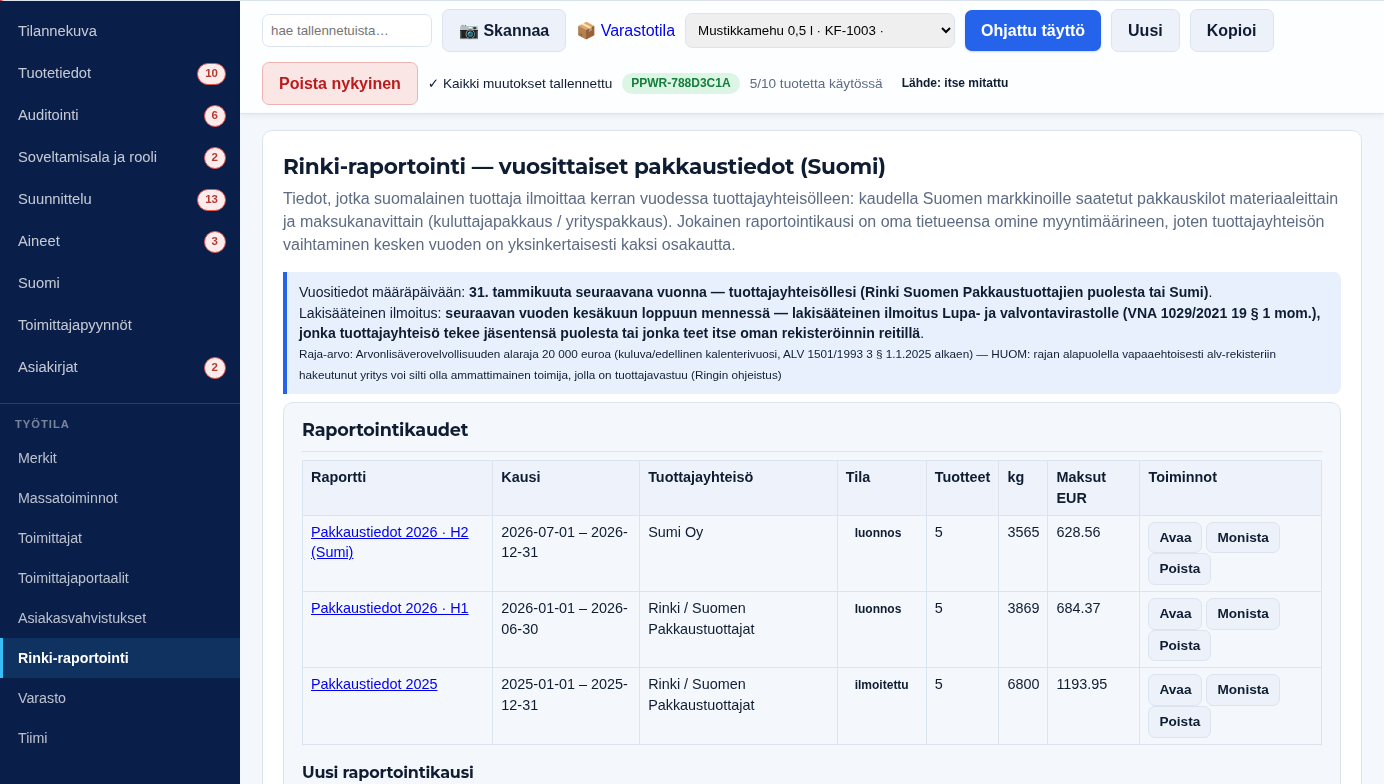
- Multi-period records: switch producer community in June and you file two partial periods. The module holds both side by side, each with its own payee and its own figures.
- Import from your ERP (enterprise resource planning system) as CSV, with explicit column mapping. The header suggests the SKU, EAN, quantity and date columns, and you confirm before the app reads anything.
- A preview that writes nothing: it counts and lists matched, unmatched and ambiguous rows, and the units land only when you apply them.
- Automatic producer-vs-distributor classification from the answers on file. Resale sourced from a Finnish operator is their report. The same product sourced from abroad is yours. Every verdict carries its reason.
- Where the answers cannot decide, the verdict reads UNDECIDED: never a guess in either direction. An override stores your note beside it.
- The gate is honest too: when no Finnish product passes the professional-operator gate, the module says no report is due instead of preparing one.
Totals you can carry into the reporting portal
Kilograms and fees per material group and channel, charts over the period, and a summary in the same taxonomy the reporting service asks in.
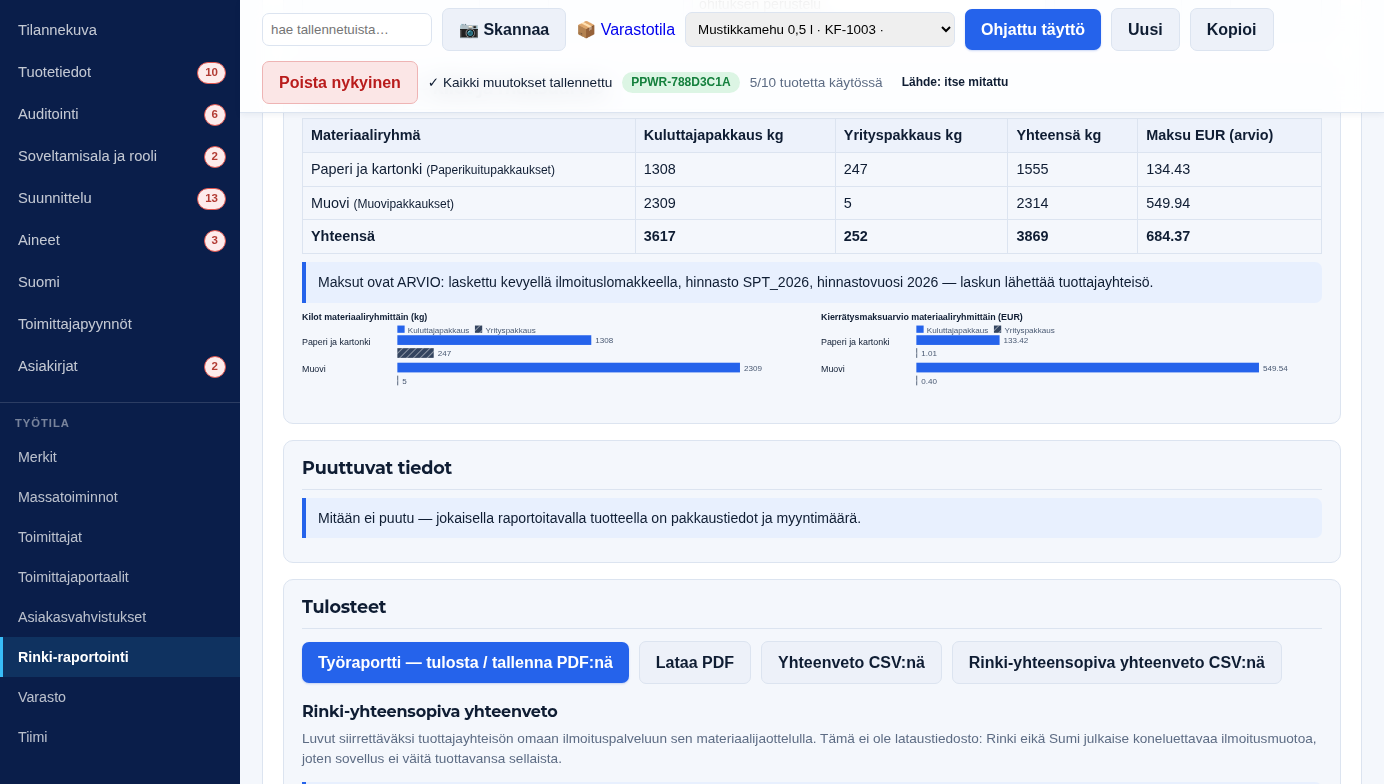
- Kilogram and fee totals per material group, split consumer / business — the same split the price lists price.
- Charts over the period's composition. Partial totals say they are partial until you close every gap.
- The module names gaps per product: missing weights, missing material codes, missing units. The exact thing to fix, not a red light.
- The Rinki-taxonomy summary to transfer into your producer community's own reporting service, with your producer identity and the period on it.
- Draft periods recompute from current product data every time they open. Marking a period filed freezes the figures, because what you reported must keep saying what you sent.
- Every figure is an estimate priced on published lists and marked with its rate year — the binding invoice is always the producer community's own.
What producer responsibility costs a small company in Finland
A producer joins a producer responsibility organisation (PRO). Finnish law calls it a tuottajayhteisö (producer community). The alternative is to register on its own, as the exception the authority grants. The approved packaging producer communities are Suomen Pakkaustuottajat Oy (SPT), served by Rinki, and Sumi Oy (jätelaki § 62, § 101). The figures below are estimates on the published price list, never amounts owed.
The 2026 fees, from the published list
On the Suomen Pakkaustuottajat 2026 price list, light form, the recycling fee is EUR 0.1020/kg for consumer fibre packaging and EUR 0.2380/kg for consumer plastic. The light form is open to producers placing under 50 000 kg a year. Both rates are VAT 0 %: VAT is added on top. The annual company service fee is EUR 0.00199/kg per contract, at least EUR 74 and at most EUR 3 890 a year.
Figures: the Suomen Pakkaustuottajat 2026 price list as encoded in dataset v2026-08-01. The community's own invoice is the binding one: check the current list on rinkiin.fi before relying on it. Sumi publishes its own list. Estimates say they are estimates.
A worked example: 800 kg of consumer fibre and 120 kg of consumer plastic
- 800 kg × EUR 0.1020 = EUR 81.60 for the fibre packaging.
- 120 kg × EUR 0.2380 = EUR 28.56 for the plastic packaging.
- Recycling fees together: EUR 110.16.
- Service fee: 920 kg × EUR 0.00199 = EUR 1.83, raised to the EUR 74 minimum.
- Total: about EUR 184 a year (EUR 184.16) before VAT at 25.5 %.
Light reporting under 50 tonnes
A producer placing under 50 tonnes a year may report in the light form. The producer community may then charge it on the averaged fee of the corresponding packaging materials (VNA 1029/2021 § 19 a). Finland's row on the country table carries the register and the deadline.
The two deadlines
There are two deadlines. By 31 January, you send your packaging data to your producer community. That is Rinki's contractual date. By the end of June, the statutory return is due to Lupa- ja valvontavirasto (VNA 1029/2021 § 19). Your producer community files that return for you. You file it yourself only if you registered on your own instead of joining a community.
What a missed registration costs
If you fail to join a producer community or to apply to the producer register, you pay a negligence fee (laiminlyöntimaksu). It is 1 % of the previous financial year's turnover, at least EUR 500 and at most EUR 500 000 (jätelaki §§ 131-132). Other listed failures cost EUR 500-10 000 (§ 132). The authority must first set a deadline of at least 30 days to remedy (§ 133).
The Finnish journey, drawn out.
Pick what your company is in Finland and the chart draws only your path. It shows every step, what it needs from you, and the violet side-steps where the Suomi and Rinki modules do the work. Click any step for the plain-language version.
This is the Finnish leg. The EU-wide PPWR journey has its own interactive map.
Manufacturer or importer
You place packaged goods on the Finnish market — your own brand, your own packing line, or imports. The full producer path is yours.
-
1. Are you a professional operator?
Producer responsibility binds an operator that acts professionally. That is the whole gate in jätelaki 646/2011 § 48. Act 1096/2022 removed the EUR 1 000 000 turnover threshold that used to sit in front of it, on 1 January 2024. The ELY Centres state the practical test in the negative: an operator established in Finland that is not liable for VAT is not acting professionally. The test does not run backwards: being liable for VAT is not on its own proof that you act professionally. If the gate says no, nothing below binds you at all.
What it needs: whether you place packaging on the Finnish market professionally, and your VAT status.
Jätelaki 646/2011 §48(1); ELY Centres on the 1 January 2024 change
-
2. Register as a producer
Almost everyone joins a producer community: Suomen Pakkaustuottajat through the Rinki service, or Sumi. The community carries the collection network and the statutory filings. Registering on your own in the producer register is an authority-granted exception, not a free choice. It carries the heavier duties: your own collection network and reporting direct to the authority. Since 12 August 2026 it also needs a security in favour of Lupa- ja valvontavirasto: at least EUR 10,000, and enough for three months of waste-management costs, lodged before the authority will approve you.
What it needs: a route decision, and your business ID (Y-tunnus).
Jätelaki §62 — own registration only where a community is manifestly unnecessary; §61 and §102 — the security
-
3. Know your packaging
The Finnish report is kilograms per material class, split by channel. Kilograms come from parts. Every product holds one row per part: material, weight, and how many units the inner box and the master carton hold. So a box's weight spreads over the units inside it. If you already built the dossier for the PPWR, this step is already done.
What it needs: a material and a weight for every component, down to the label and the tape.
The same product record every other module reads
-
4. Consumer or business, per part
The app prices every part on one of two rate columns. The consumer column is the expensive one, often several times the business rate for the same kilogram. The test is where the packaging ends up, not who you invoice. Packaging sold to a business still counts as consumer packaging when it ends up with consumers or households. In doubt, choose consumer.
What it needs: an answer to who buys the product — the app defaults every part from it.
Kuluttajapakkaus vs yrityspakkaus, on each operator's own price list
-
5. Collect the year's volumes
The kilograms are per-unit weights multiplied by the units each product sold in the period. Nobody types four hundred unit counts by hand. The figures live in your ERP, and the job is getting them out of it and onto the right products.
What it needs: an export from your sales system with a product code and a quantity.
Units belong to a reporting period, not to the product
-
6. Compile the period report
One record per filing period, covering the whole catalogue. The module classifies every product: in your report or not, with the reason spelled out. The kilograms and fee estimate per material class and channel follow from data you already hold. Switch producer community mid-year and you simply file two partial periods, each with its own payee.
What it needs: the units from the step above — everything else is already in the dossiers.
Multi-period records; totals say they are partial until every gap closes
-
7. File it — and know your two deadlines
There are two deadlines. By 31 January, you send your packaging data to your producer community. That is Rinki's contractual date. By the end of June, the statutory return is due to Lupa- ja valvontavirasto (VNA 1029/2021 § 19). Your producer community files that return for you. You file it yourself only if you registered on your own instead of joining a community. When you have filed, mark the period filed in the app too.
What it needs: transferring the summary into the community's service, and one click to freeze the period.
VNA 1029/2021 §19(1); the community's own 31 January contractual deadline
-
8. Beverages: the deposit scheme is separate
A deposit bottle or can does not leave producer responsibility. The deposit system is its own membership with its own fees, run by Palpa. Belonging to an approved return system is what lifts the beverage-package excise. The app screens the container: deposit class by type and volume, the reverse-vending geometry window, the barcode rules.
What it needs: the container type, volume and dimensions from the label spec.
Palpa terms; beverage-package excise avoided through an approved return system
Reported, filed, frozen. Every Finnish product classified with a reason, the kilograms and fees computed per class and channel, the summary transferred, the period frozen as filed. Next year is the same record with new units.
Reseller
You resell products someone else already placed on the Finnish market. Where you buy them decides everything.
-
1. Whose packaging is it?
Pure resale of another company's product carries no Finnish producer responsibility, as long as a Finnish operator placed the goods on the Finnish market. Buy the same product from abroad and the picture flips. You are the importer, and the importer is the Finnish producer even when it only distributes.
What it needs: where each product is bought from — a Finnish operator, another Member State, or outside the EU.
Jätelaki §48 — the importer is a producer
-
2. Verify the upstream producer
Where the producer is a Finnish operator, the producer responsibility is theirs. Checking it is yours: since 12 August 2026 it is a distributor's duty, not a courtesy. Before you sell their packaging, verify that the producer is in the producer register or a producer community (Art 19(2)(a)). Check too that the packaging carries the manufacturer's identification and contact details and, for imports, the importer's (Art 19(2)(c)), and that it is labelled in line with Art 12 (Art 19(2)(b)). Since 12 August 2026 that means no label, mark or symbol likely to mislead or confuse end users about its sustainability requirements, characteristics or waste management (Art 12(8)); the harmonised material label joins the check once Art 12(1) applies, from 12 August 2028 at the earliest. These are checks, not paperwork. Record them.
What it needs: the producer's name and their registration number.
-
3. Your report holds only what is yours
A reseller's catalogue is a mix: some products bought at home, some imported, some unclear. The reporting module lists each group separately. Where the answers cannot decide, the verdict reads UNDECIDED, never a guess in either direction. Both mistakes cost real money. Reporting someone else's packaging pays their fees, and omitting your own under-reports a statutory filing.
What it needs: a decision on each undecided product — one click, include or exclude.
Honest UNDECIDED, decided by you
One catch worth knowing: buy from another EU country and resell at home, and you are the producer here. The register and the fees come with it. The toolkit checks that for you and says so.
Clear about whose report is whose. Finnish-sourced products verified and left to their producer. Imports counted in your own report. Nothing left undecided. That settles the reseller's Finnish producer responsibility: knowing which side of the line each product is on. The Art 19 distributor checks sit on top of it, before you sell each product.
Distance seller into Finland
You sell into Finland from abroad, directly to end users — producer duties without a Finnish establishment.
-
1. Producer duties without an establishment
Sell packaged goods from abroad directly to Finnish end users and you are the Finnish producer for that packaging — no establishment needed. A business that uses the goods itself is an end user too, so selling to it directly still makes you the producer. Selling to a Finnish business that resells the goods makes that business the producer instead, not you. So the first job is sorting your Finnish sales into those two boxes.
What it needs: which Finnish sales go directly to end users — consumers, or businesses that use the goods themselves — and which go to businesses that resell them.
Jätelaki ch. 6 — distance sales direct to end users
-
2. Register from abroad
Do you sell packaged goods by distance sale directly to end users in Finland from another country? Then from 12 August 2026 you must appoint, by written mandate, an authorised representative established in Finland for producer responsibility (Regulation (EU) 2025/40 Art 45(3)). Jätelaki § 66 a refers packaging to that Article. The representative is treated as the producer: it joins Suomen Pakkaustuottajat via Rinki or Sumi, or registers, and files for you. Producers established outside the EU fall under the same first sentence of Art 45(3), because the Art 3(1)(15)(c)-(d) producers it covers include those established in a third country; its second sentence also lets each Member State require the appointment from third-country producers. In Finland a representative is always named by written mandate (jätelaki § 66 b). Lupa- ja valvontavirasto's distance-seller guidance lists packaged products among the categories where the representative is the route.
What it needs: a written mandate with a representative established in Finland, and your home-country registration number.
Regulation (EU) 2025/40 Art 45(3); jätelaki §§ 66 a and 66 b
-
3. Then the same reporting as everyone else
Distance selling changes who owes the report, not what the report is. The destination test per part is the same. The units per period and the kilograms per material class and channel are the same. So are the two deadlines: 31 January to the community, end of June to the authority.
What it needs: the same product data and period units the producer path collects.
One engine, whoever the producer is
A producer in Finland, run from abroad. Represented in Finland by written mandate, reporting on time, with the same frozen filed periods as a domestic producer. A clear line between the sales to end users, consumers and businesses alike, that made you a producer and the sales to resellers that did not.
What the app deliberately does not do.
A compliance tool earns trust by knowing where its authority ends. Three lines this product does not cross.
The filing happens in your community's own channel
The app prepares the figures and the summary in the community's taxonomy. It does not press the button. Neither Rinki nor Sumi publishes a machine-readable submission format, so the app does not pretend to produce an upload file.
Deposit-scheme artwork comes from Palpa
For a deposit container the app screens the deposit class, the reverse-vending geometry and the barcode rules, and writes the request. The deposit and material marks themselves are Palpa's official artwork, never drawn here.
Estimates say they are estimates
The app computes fees on the operators' published price lists and marks them with their rate year. The binding invoice is always the producer community's own. Verify against the current list before filing.
Finnish producer responsibility, in six answers
Does a small company have to register for packaging producer responsibility in Finland?
Yes, if it professionally places packaging on the Finnish market or sells packaged goods by distance sale directly to Finnish users (jätelaki 646/2011 § 48(1)). There has been no turnover threshold since 1 January 2024. The EUR 1 000 000 floor in the old § 48(2) applied for the last time to 2023 (act 1096/2022). The ELY Centres, and now Lupa- ja valvontavirasto, treat an operator established in Finland that is not liable for VAT as not acting professionally. Rinki states it the other way round: VAT-registered means professional operator. But that is scheme guidance. Being liable for VAT is not on its own proof that you act professionally. Sources: jätelaki 646/2011, ELY Centres, Rinki.
Which register: Rinki, Sumi or your own?
Join an approved producer community: Suomen Pakkaustuottajat Oy, served by Rinki, or Sumi Oy (jätelaki § 62). Own registration in the producer register at Lupa- ja valvontavirasto is the exception the authority grants on application (§ 101). The community files the statutory return for you (VNA 1029/2021 § 19). You file it yourself only on the own-registration route. Sources: jätelaki 646/2011, VNA 1029/2021.
What changes for transport packaging on 12 August 2026?
From 12 August 2026 jätelaki § 48(1) item 6 defines the packaging producer by reference to PPWR Art 3(1)(15) (act 648/2026). The producer of transport packaging is the one who first makes it available in Finland: the packaging manufacturer or importer (Art 3(1)(15)(a)). It is no longer the company that packs the goods. Service and primary-production packaging moved earlier, on 1 January 2024. Sources: jätelaki 646/2011, Lupa- ja valvontavirasto.
What are the two reporting deadlines?
There are two deadlines. By 31 January, you send your packaging data to your producer community. That is Rinki's contractual date. By the end of June, the statutory return is due to Lupa- ja valvontavirasto (VNA 1029/2021 § 19). Your producer community files that return for you. You file it yourself only if you registered on your own instead of joining a community. Sources: VNA 1029/2021, Rinki.
What are the four things a micro-enterprise should do now that the PPWR applies?
First, list your packaging and its materials: that is the start of the Annex VII technical documentation (Art 15(2)). Second, work out whether you are the producer in Finland and elsewhere (Art 3(1)(15); jätelaki § 48(1)) and register or join a producer community. Third, ask your packaging supplier for the Art 5 data and the documentation it must give you (Art 5(4)-(5), Art 16). Fourth, sign the Annex VIII declaration of conformity if you are the manufacturer, or file the manufacturer's copy if you import (Art 39; Art 18(7)). A micro-enterprise whose packaging supplier is in the Union can leave the Art 15 duties to that supplier (Art 15(12)). Informational, not legal advice.
Who is the producer from 12 August 2026 if the goods carry our own brand?
Producer responsibility follows who first makes the packaged product available in Finland, not whose brand is on the pack. From 12 August 2026 jätelaki § 48(1) point 6 defines the packaging producer by reference to PPWR Art 3(1)(15) (act 648/2026). If you are established in Finland and are the first to make your own-brand goods available on the Finnish market from within Finland, you are the producer (Art 3(1)(15)(b)): join a producer community or register (jätelaki § 62, § 101). If a Finnish importer brings your branded goods in and first makes them available here, that importer is the producer. Two micro-enterprise rules: a packaging supplier in the same Member State is the manufacturer for the whole Regulation (Art 3(1)(13)(b)); a supplier elsewhere in the Union takes over the Art 15 duties only (Art 15(12)). Neither moves producer responsibility. Sources: Regulation (EU) 2025/40, jätelaki 646/2011.
The Micro plan does this for five products at EUR 4.90 a month.
Start where the fees actually land.
Fourteen days free, five products, no credit card. Load your catalogue, answer the Finnish questions once, and watch the period report compute itself.